Political Parties ARENA & FMLN
For three decades, ARENA and the FMLN dominated Salvadoran politics. Today, both parties struggle to remain relevant after three consecutive electoral defeats that reshaped El Salvador’s political landscape.
The turning point came in 2019, when Nayib Bukele won the presidency, ending 30 years of alternating rule between the two parties. The 2021 and 2024 elections further weakened their political influence.
Both parties lost legislative seats, municipal governments, and voter support, leaving them with limited political influence. With the 2027 elections approaching, ARENA and the FMLN face another major test as they attempt to rebuild their political standing.
- The 2019 Election: The Beginning of ARENA and FMLN’s Collapse
- The 2021 Elections Deepened Their Political Decline
- The 2024 Elections Confirmed Their Collapse
- ARENA and FMLN’s Electoral Performance
- Why Have ARENA and the FMLN Lost Political Support?
- What Do Public Opinion Polls Reveal?
- Can ARENA and the FMLN Rebuild Their Influence?
- What Are Their Chances in the 2027 Elections?
- The Future of ARENA and the FMLN
The 2019 Presidential Election Marked the Beginning of ARENA and FMLN’s Collapse
The 2019 presidential election transformed Salvadoran politics. Nayib Bukele won the presidency under the GANA party banner, defeating ARENA and the FMLN and ending three decades of political dominance by both organizations.
ARENA had governed El Salvador from 1989 to 2009, while the FMLN controlled the presidency from 2009 to 2019. Together, they shaped much of the country’s postwar political history.
How Nayib Bukele Ended Three Decades of Two-Party Dominance:
Bukele’s victory showed how frustrated many Salvadorans had become with traditional politicians. Many Salvadorans had grown dissatisfied with corruption scandals, persistent insecurity, economic difficulties, and the inability of successive governments to deliver meaningful improvements.
His campaign offered voters an alternative to the established political system. Instead of choosing between ARENA and the FMLN, Salvadorans could support a candidate who openly challenged both parties.
ARENA and FMLN Suffer Major Presidential Defeats:
ARENA entered the 2019 election hoping to regain the presidency after ten years in opposition. However, its presidential coalition received approximately 857,000 votes, finishing far behind Bukele.
The FMLN performed even worse. After governing for a decade, the left-wing party received approximately 390,000 votes, demonstrating how dramatically its electoral support had deteriorated.
Both parties retained considerable legislative and municipal representation following the presidential election. However, their presidential defeats exposed a political weakness that would become much more apparent in subsequent elections.
The 2021 Elections Deepened the Political Decline of ARENA and the FMLN
The 2021 legislative and municipal elections delivered another major setback for El Salvador’s traditional political parties. This time, their losses extended beyond the presidency into the institutions they had controlled for decades.
Nuevas Ideas, Bukele’s political party, secured a commanding legislative majority. The results substantially weakened ARENA and the FMLN’s ability to influence legislation or challenge the president’s political agenda.
ARENA and FMLN Lose Legislative Representation:
ARENA entered the 2021 elections with 37 legislative seats, including coalition representation. Following the election, its representation dropped to 14 deputies in the 84-member Legislative Assembly.
The FMLN suffered a similarly dramatic decline, falling from 23 legislative seats to just four. The results demonstrated that both parties had lost substantial support among Salvadoran voters.
Municipal Elections Reveal Declining Local Influence:
The municipal elections showed the same trend. ARENA went from controlling 139 mayoralties in 2018 to just 35 in 2021, while the FMLN dropped from 66 to 30.
These losses hit both parties hard. For years, local governments helped ARENA and the FMLN build strong community ties, develop local leaders, and maintain political support across El Salvador.
The 2024 Elections Confirmed the Collapse of El Salvador’s Traditional Political Parties
The 2024 elections delivered the strongest evidence yet of ARENA and the FMLN’s political decline. Both parties experienced another significant reduction in electoral support, leaving their future increasingly uncertain.
Bukele won reelection with approximately 82.7% of the valid presidential vote, while ARENA and the FMLN together received less than 12%, according to official electoral results.
ARENA and FMLN Receive Historically Low Presidential Support:
The FMLN finished second in the presidential election with 204,167 votes, representing 6.25% of the valid vote. ARENA finished third with 177,881 votes, equivalent to 5.44%.
Together, both parties received 382,048 presidential votes, compared with approximately 1.24 million in 2019. That represented a combined decline of nearly 70% between the two elections.
Legislative and Municipal Representation Shrinks Further:
ARENA secured only two seats in the 60-member Legislative Assembly. The FMLN failed to win a single seat, leaving the former governing party without legislative representation.
The municipal elections brought similarly disappointing results. ARENA won just one of the country’s 44 municipalities, while the FMLN failed to secure any municipal government.
These results left both parties with limited institutional influence and fewer opportunities to rebuild their political organizations through elected representation.
Electoral Reforms Changed the Political Landscape:
The 2024 elections also took place under a significantly different electoral system. Lawmakers reduced the Legislative Assembly from 84 to 60 seats and consolidated 262 municipalities into 44.
These changes complicate direct comparisons between elections. Nevertheless, the dramatic decline in presidential votes and legislative representation provides clear evidence of both parties’ weakened electoral standing.
Comparing ARENA and FMLN’s Electoral Performance Since 2019
The election results show how quickly El Salvador’s traditional political parties lost their influence. ARENA and the FMLN lost ground in presidential elections, the Legislative Assembly, and municipal governments across the country.
| Election | ARENA | FMLN |
|---|---|---|
| 2019 presidential votes | 857,084* | 390,000 |
| 2021 legislative seats | 14 | 4 |
| 2024 presidential votes | 177,881 | 204,167 |
| 2024 legislative seats | 2 | 0 |
| 2024 municipalities won | 1 | 0 |
The numbers reveal a consistent pattern. Neither party has managed to reverse its electoral decline, and both have lost much of the political influence they once exercised nationwide.
Why Have ARENA and the FMLN Lost So Much Political Support?
Several factors explain the decline of ARENA and the FMLN. Although the parties represent different political ideologies, both have struggled with similar problems involving credibility, leadership, and public confidence.
Corruption Scandals and the Loss of Public Trust:
Corruption allegations involving former government officials damaged the reputation of both parties. High-profile cases reinforced public perceptions that traditional political leaders had placed personal and partisan interests above national priorities.
ARENA and the FMLN also struggled to distance themselves from their political histories. For many voters, changing party leadership wasn’t enough to restore confidence in organizations associated with previous administrations.
The Rise of Bukele and Nuevas Ideas:
Bukele’s popularity created another significant challenge. His government’s security policies, particularly the crackdown on gangs, helped strengthen his political standing among Salvadorans who had experienced years of insecurity.
However, human rights organizations have also criticized the security strategy, raising concerns about alleged arbitrary arrests, violations of due process, and poor prison conditions. These issues continue to fuel political debate across El Salvador.
Leadership Problems and a Weak Political Alternative:
Both parties have struggled to develop leadership capable of attracting voters beyond their traditional supporters. Their political messages often compete against a president with substantial public support and a strong communication strategy.
Opposing government policies alone hasn’t produced an electoral recovery. To regain influence, ARENA and the FMLN must convince voters that they offer credible solutions to everyday problems.
What Do Public Opinion Polls Reveal About ARENA and FMLN?
Recent public opinion polls show just how much ARENA and the FMLN continue to struggle. Neither party has managed to regain the widespread political support it had before 2019.
A June 2026 survey by the University of Central America’s Public Opinion Institute (IUDOP) found that Nuevas Ideas remained far ahead of the country’s traditional political parties.
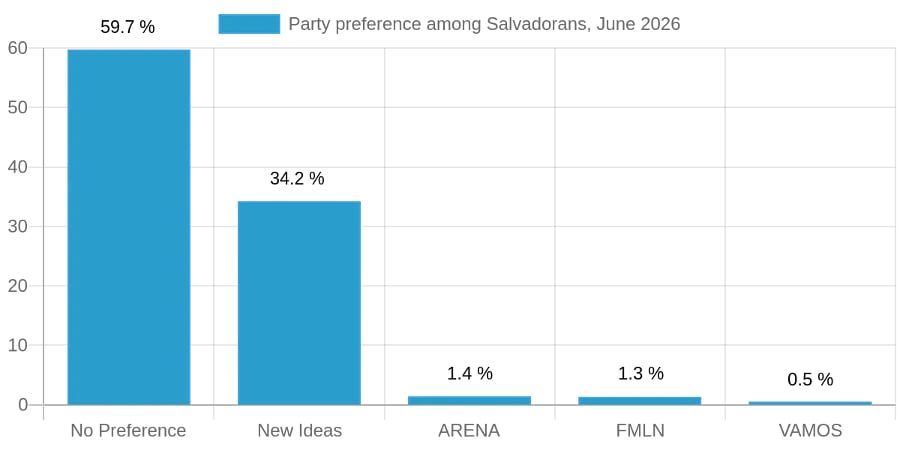
The survey found that nearly six in ten respondents don’t support any political party. This shows that many Salvadorans feel disconnected from politics, but it doesn’t mean they’re ready to support traditional opposition parties.
The same polling also showed Nuevas Ideas leading presidential voting intentions by a considerable margin, while ARENA and the FMLN registered support in the low single digits.
Can ARENA and the FMLN Rebuild Their Political Influence?
To regain political ground, ARENA and the FMLN need to do more than change candidates or launch new campaigns. They must win back voters’ trust, strengthen their parties, and show Salvadorans that they understand the issues that matter most to them.
ARENA needs to offer voters a fresh center-right alternative instead of relying on its past. Meanwhile, the FMLN needs to reconnect with voters who no longer support its traditional left-wing ideas.
Both parties could benefit from new leadership, younger candidates, and closer ties with local communities. But they can’t expect voters unhappy with the government to automatically support the opposition.
Political alliances could also help both parties compete in key districts. However, parties with different political views would need to find common ground and convince voters that their partnerships offer more than just electoral convenience.
What Are ARENA and FMLN’s Chances in the 2027 Elections?
El Salvador will hold its next general elections on February 28, 2027. Voters will choose the president, Legislative Assembly deputies, and municipal authorities on the same day.
The political landscape has also changed. In 2025, lawmakers approved constitutional reforms that allow presidents to seek reelection indefinitely, extend presidential terms from five to six years, and eliminate the need for a presidential runoff election.
Why Significant Electoral Gains Appear Unlikely:
The results from 2019, 2021, and 2024 reveal a big decline in political support. Recent polling provides little evidence that either party has developed enough momentum to reverse that trend.
Both organizations have selected presidential candidates for 2027. ARENA nominated former legislator Maytee Iraheta, while the FMLN chose physician and union leader Rafael Aguirre.
Nevertheless, selecting candidates doesn’t guarantee renewed electoral competitiveness. The parties still face the difficult task of persuading voters who have repeatedly rejected them at the ballot box.
The Future of ARENA and the FMLN in Salvadoran Politics
ARENA and the FMLN remain part of El Salvador’s political history, but their future influence is far from guaranteed. Three consecutive electoral defeats have left both parties substantially weaker than before 2019.
To make a comeback, both parties need to regain public trust, bring in credible leaders, and offer real solutions to the problems Salvadorans face.
The 2027 elections will give both parties another chance to test their public support. However, past election results and available polls suggest they still face an uphill battle to regain lost ground.
For now, the biggest question isn’t whether ARENA and the FMLN can return to their glory days. It’s whether they can win back enough public trust to become serious political alternatives again.