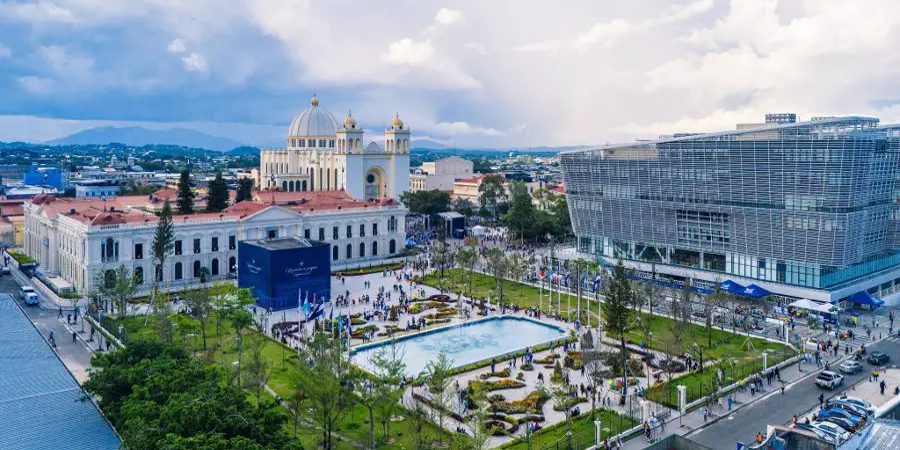
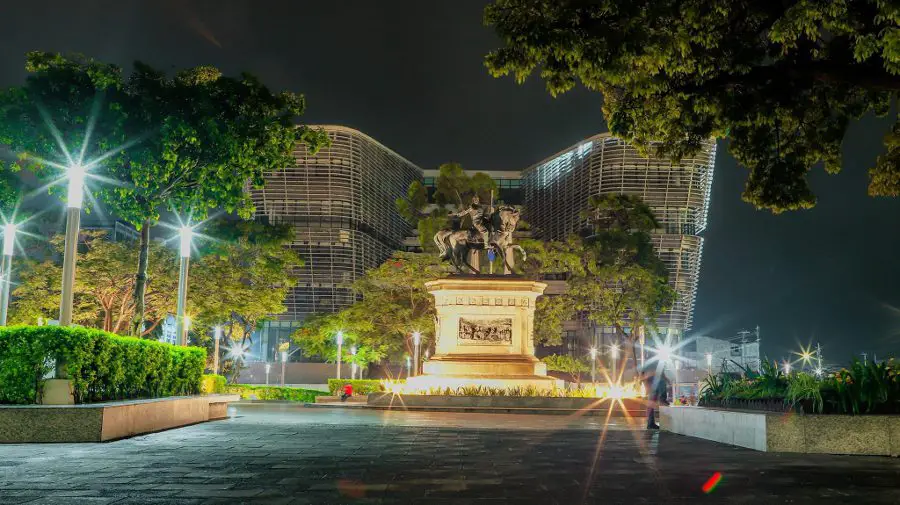
 Downtown San Salvador, El Salvador.
El Salvador may be the smallest country in Central America, but its politics have never been simple. Revolutions, military governments, civil war, democratic reforms, and changing political movements have all shaped how El Salvador works today.
To understand how El Salvador’s government works, you need to look beyond presidents and elections. The Constitution sets the rules, creates government institutions, protects individual rights, and establishes how Salvadorans elect their representatives.
In Recent years, El Salvador’s political system has changed. The country has changed presidential terms, reelection rules, legislative representation, and local government, reshaping a system that had stayed mostly the same for decades.
How the Government of El Salvador Works
El Salvador is a republic governed under a constitutional system. Political authority operates through institutions responsible for making laws, administering the country, resolving legal disputes, and overseeing elections and public administration.
The country’s national government is divided into three main branches: executive, legislative, and judicial. Each branch has its own responsibilities, but they often cross paths.
The Constitution provides the legal foundation for this system. It establishes the structure of government while defining citizenship, political participation, individual guarantees, public institutions, and the responsibilities of state authorities.
The Executive Branch
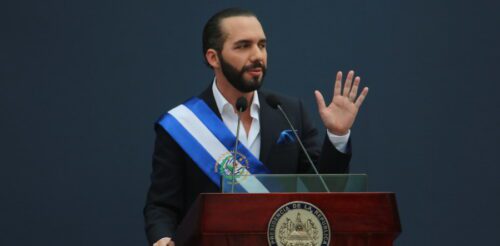
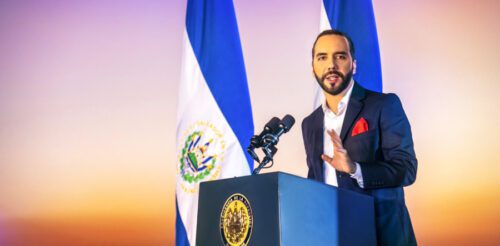
The president leads the executive branch and serves as both head of state and head of government. Salvadorans elect the president and vice president through national elections.
The executive branch puts government policies into action and manages ministries that handle areas such as education, health, finance, public works, security, foreign affairs, agriculture, and labor.
El Salvador has also changed some of its long-standing presidential rules. Constitutional reforms approved and ratified in 2025 allow presidents to seek reelection without term limits and extend presidential terms from five to six years.
The reforms also eliminated presidential runoff elections and changed the election schedule. Presidential, legislative, and municipal elections will now take place during the same election cycle, significantly changing how El Salvador organizes national elections.
The Legislative Branch
Legislative Assembly is the country’s lawmaking body. Deputies debate and approve legislation, adopt the national budget, ratify certain international agreements, and make decisions involving other government institutions.
The Assembly currently consists of 60 principal deputies and an equal number of alternates. The number fell from 84 to 60 following reforms to the Electoral Code approved in 2023.
Representation has traditionally been organized through electoral constituencies connected to the country’s departments. Beginning with the 2027 election cycle, six legislative seats are designated for a new overseas constituency representing Salvadorans living abroad.
The Legislative Assembly does more than make and pass laws. Deputies also choose the people who lead several key public institutions, so their decisions can shape how the Salvadoran government works.
The Judicial Branch
El Salvador’s judicial branch interprets the law and oversees how courts apply it across the country. The Supreme Court of Justice oversees El Salvador’s judicial system, while lower courts deal with criminal, civil, constitutional, administrative, and other legal cases.
The Supreme Court divides its work among four specialized chambers: Constitutional, Civil, Criminal, and Administrative Litigation. Each chamber focuses on a different area of Salvadoran law and handles cases related to its specialty.
The Constitutional Chamber plays an especially important role. It handles constitutional disputes and proceedings involving matters such as habeas corpus, constitutional protection, and challenges to the constitutionality of laws or government actions.
Elections in El Salvador
Voting gives Salvadorans their most direct role in national politics. Citizens elect the president and vice president, members of the Legislative Assembly, and municipal councils through elections administered by the Tribunal Supremo Electoral.
The Tribunal Supremo Electoral, better known as the TSE, runs and oversees elections in El Salvador. It also provides election results, voting statistics, political party information, and the country’s electoral calendar.
Electoral rules can change through constitutional and legislative reforms. For that reason, readers following Salvadoran politics should distinguish between the country’s permanent electoral institutions and rules that may change between election cycles.
Political Parties in El Salvador
Political parties have played a central role in El Salvador’s modern democratic history. The only path to serving as an elected public official is through a political party.
Political parties nominate candidates, organize political movements, compete for elected office, and offer voters competing visions of government.
For decades after the civil war, ARENA on the right and the FMLN on the left dominated politics in El Salvador. The two parties took turns governing the country during much of the postwar era.
That two-party dominance was eventually broken as a new political movement gained support. The New Ideas Party brought an end to the political and governmental control held by ARENA and FMLN.
Municipal Government and Administrative Divisions
In 2023, Salvadoran lawmakers approved one of the biggest changes to local government in decades. They reduced the number of municipalities but kept the former municipalities as districts within the new structure.
El Salvador remains divided into 14 departments, but it now has 44 municipalities containing 262 districts. Before the restructuring, the country had 262 municipalities and the same 14 departments.
Each municipality has a municipal council headed by a mayor. These local governments deal with community-level administration and services, making municipal politics one of the areas where residents interact most directly with government.
The 262 former municipalities didn’t disappear. Instead, the government turned them into districts within 44 larger municipalities.
The Constitution of El Salvador
El Salvador has relied on its current Constitution since 1983. Over the years, lawmakers have amended it, while court decisions have helped shape how the country interprets and applies its provisions.
It establishes fundamental rights and outlines the responsibilities of major government institutions. It also provides the framework governing political participation, elections, public authority, citizenship, and relationships among different parts of the state.
Constitutional rules can change. Lawmakers can change the political system through amendments, including rules on presidential reelection, term lengths, election schedules, and how electoral institutions work.
A Brief History of Politics in El Salvador
Modern Salvadoran politics can’t be fully understood without its turbulent history. During much of the twentieth century, military governments, political repression, economic inequality, and social conflict influenced the country’s political development.
Those tensions eventually contributed to the Salvadoran Civil War, fought between the government and the Farabundo Martí National Liberation Front, or FMLN. The conflict lasted through much of the 1980s and early 1990s.
The 1992 Peace Accords brought the armed conflict to an end and helped transform the political system. The FMLN moved from an armed movement into electoral politics and became a major political party.
After the civil war, ARENA and the FMLN dominated Salvadoran politics for decades. ARENA held the presidency from 1989 to 2009, before the FMLN won two consecutive presidential elections.
Another major political shift arrived with the rise of Nayib Bukele and, later, Nuevas Ideas. Their electoral success weakened the postwar ARENA-FMLN political order and changed the balance of political power.
Presidents and parties will continue to change. The larger story of Salvadoran politics, however, involves the relationship between voters, elected leaders, constitutional rules, public institutions, and the limits placed on government power.
Checks, Balances, and Public Institutions
Government authority extends beyond the three main branches. El Salvador also has institutions responsible for elections, public finances, criminal prosecution, human rights oversight, government auditing, and other areas of public administration.
The Legislative Assembly participates in selecting officials for several of these institutions. That responsibility makes legislative elections important beyond determining which political parties control debates and votes inside the Assembly itself.
Institutions such as the Supreme Court, Attorney General’s Office, Court of Accounts, and TSE play important roles in El Salvador’s government. These institutions interpret laws, monitor public spending, run elections, and investigate crimes.
Their independence often sparks political debate. Salvadorans regularly discuss whether these institutions can do their jobs without political interference and effectively provide checks and balances on the government and other public institutions.
Security and the Role of the State
Public security plays a major role in Salvadoran politics. For decades, gang violence, organized crime, migration, and concerns about personal safety have kept security policies at the center of the country’s political debate.
The National Civil Police (PNC) handles everyday policing and public security in El Salvador, while the Armed Forces have their own constitutional duties. Over the years, the government has also sent soldiers to work alongside police during domestic security operations.
El Salvador’s Constitution allows the government to temporarily suspend certain constitutional rights during exceptional situations. These provisions make states of exception an important subject within the country’s constitutional and political system.
Security policy often creates debate over competing government responsibilities. Authorities must address crime and public safety while constitutional institutions also determine how individual rights, legal procedures, and government powers apply.
El Salvador and the International Community
Foreign relations play an important role in Salvadoran politics and the country’s economy. El Salvador maintains diplomatic and economic ties across the Americas, Europe, Asia, and other regions while participating in regional and international organizations.
Relations with the United States remain especially important because of trade, migration, security cooperation, and diplomacy. The large Salvadoran community in the United States also creates strong economic, cultural, and political connections between both countries.
El Salvador also works closely with its Central American neighbors on regional issues. Trade, migration, security, economic development, and infrastructure regularly require cooperation that extends beyond the country’s borders.
Salvadorans living abroad have also gained a stronger voice in national politics. They can participate in elections, while electoral reforms have expanded the diaspora’s role within El Salvador’s political system.
Under President Nayib Bukele, El Salvador has also pursued a more unconventional international profile. His government developed close ties with U.S. President Donald Trump, particularly around migration and security cooperation.
At the same time, El Salvador has attracted international attention through its security policies, growing tourism industry, investment initiatives, and experimentation with Bitcoin and other technology-focused economic policies.
These developments have given the country greater international visibility. They also show how El Salvador balances longstanding relationships with newer diplomatic, economic, and political strategies as it defines its place on the global stage.
Understanding Politics in El Salvador
Salvadoran politics makes more sense when you separate the people holding power from the institutions they temporarily control. Presidents, deputies, mayors, judges, and political parties change; government structures usually change more slowly.
Keeping that in mind also makes political news easier to follow. Elections may dominate the headlines for weeks, but constitutional reforms, electoral rules, and major court decisions can influence El Salvador for decades.
El Salvador’s political system keeps changing, as it has throughout its history. When you understand how its main institutions work, you can better follow those changes and see how each political development fits into the bigger picture.