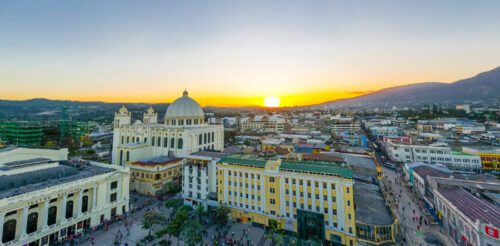
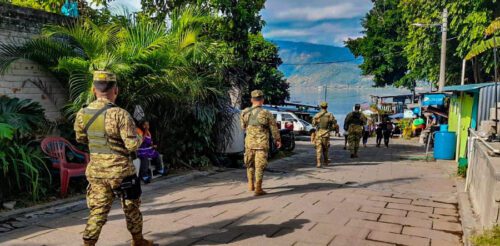
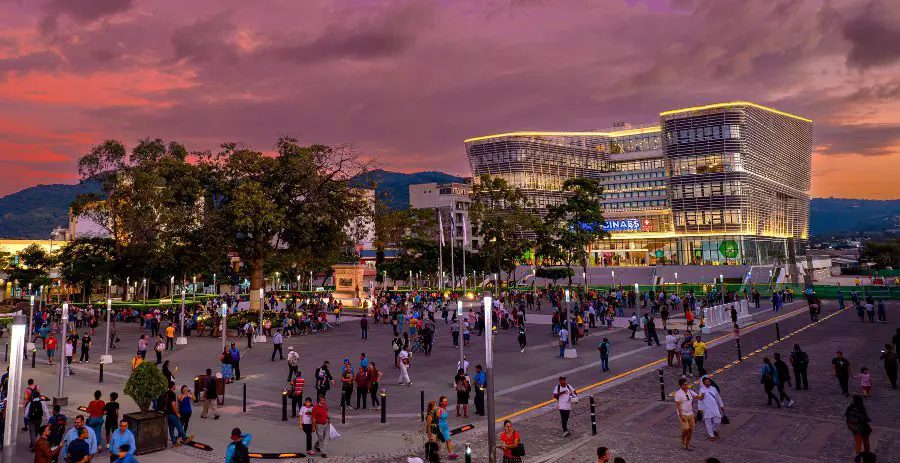
 National Library in San Salvador Downtown.
El Salvador’s security was once defined by widespread violence, earning the country a reputation as the “murder capital of the world.” Today, that image has changed dramatically, and El Salvador has emerged as one of Latin America’s safest countries.
Security reforms implemented by the Bukele administration have dismantled gangs, reduced homicides, and reclaimed public spaces. Daily life in El Salvador has shifted from fear to normalcy.
Nowadays, people across El Salvador are experiencing improved safety in their neighborhoods, on public transportation, at night, and in everyday life.

The Murder Capital of the World
El Salvador’s reputation for violence was not an exaggeration. For years, the country was known as the “Murder Capital of the World,” a label that defined its modern history.
From the 1990s through 2019, El Salvador struggled with one of the world’s most severe security crises involving violence. Gang wars, drug trafficking, and political instability pushed homicide rates to levels rarely seen in countries not at war.
The deadliest year was 2015, when 6,656 people were murdered. That amounted to an average of 18.2 killings per day and a homicide rate of 106.3 per 100,000 residents. During 2015, the country had nearly one homicide an hour.
| Year | Total Homicides | Daily Homicide Rate | Homicides per 100,000 Inhabitants |
|---|---|---|---|
| 2026 *Oct 20 | 49 | 0.17 | 0.96 |
| 2025 | 82 | 0.22 | 1.36 |
| 2024 | 114 | 0.31 | 1.89 |
| 2023 | 156 | 0.43 | 2.4 |
| 2022 | 495 | 1.36 | 7.8 |
| 2021 | 1152 | 3.16 | 18.1 |
| 2020 | 1341 | 3.67 | 21.2 |
| 2019 | 2398 | 6.57 | 35.8 |
| 2018 | 3346 | 9.17 | 50.4 |
| 2017 | 3962 | 10.85 | 60.2 |
| 2016 | 5280 | 14.47 | 81.0 |
| 2015 | 6656 | 18.24 | 106.3 |
| 2014 | 3921 | 10.74 | 61.3 |
| 2013 | 2513 | 6.88 | 40.6 |
For many Salvadorans, fear shaped daily life. Families followed informal curfews and avoided going out after dark, while businesses often closed early because of insecurity.
Parents constantly worried about their children’s safety. Traveling to school or work could be dangerous. At the same time, gangs demanded “rent,” or extortion payments, from businesses, workers, transportation operators, and residents.
The violence also contributed to migration. Thousands of Salvadorans left the country, with many heading north to the United States in search of greater security and better opportunities.
International headlines branded the country unlivable. News outlets routinely described El Salvador as the “murder capital of the world,” cementing its image as the hemisphere’s deadliest nation.
That reputation also hurt tourism and discouraged investment. International companies faced significant security concerns, while Salvadorans living abroad often dealt with the stigma associated with their country’s violent image.
Entire communities adapted to living under constant threat. Invisible boundaries separated gang-controlled territories, and entering the wrong neighborhood could have serious or even deadly consequences.
By 2019, El Salvador was still dealing with the effects of decades of violence. Insecurity had changed everyday life and left a lasting mark on the country’s communities, economy, politics, migration, and international image.
The Turning Point: Security Policies and Crackdowns
The turning point in El Salvador’s security came in 2019, when years of unchecked gang violence gave way to an unprecedented gang crackdown that redefined the nation’s future.
President Nayib Bukele took office on June 1, 2019, promising to address El Salvador’s gang problem. Soon after taking office, his administration launched the Territorial Control Plan, an aggressive security strategy targeting gangs and looking to reclaim neighborhoods long dominated by violent gangs.
In March 2022, the government introduced the State of Exception following a deadly surge in homicides. The measure gave authorities expanded powers and led to a massive nationwide gang crackdown.
The Bukele administration also introduced a new prison strategy and built the Terrorism Confinement Center (CECOT), a maximum-security prison designed to hold thousands of suspected and convicted gang members.
The Territorial Control Plan
The Territorial Control Plan became the Bukele administration’s main security strategy for confronting gangs and reducing violence in El Salvador. Launched in June 2019, the plan introduced a new approach to restoring government control over communities.
The strategy consists of seven phases designed to address different aspects of public security. The first six are Preparation, Opportunity, Modernization, Incursion, Extraction, and Integration, with each phase introducing additional measures and resources.
The seventh phase has not been publicly detailed or officially named. It was designed as an emergency or contingency phase that could be implemented if the first six phases failed to achieve their objectives.
For a deeper look at each phase, its objectives, implementation, and results, visit our “Territorial Control Plan“ page for more details about one of El Salvador’s most important security strategies.
The State of Exception
El Salvador’s State of Exception became the Bukele administration’s most direct strategy for confronting gangs. It was introduced in late March 2022 following a violent weekend in which 87 people were killed.
The emergency measure restricted certain constitutional rights, including protections involving freedom of association, communications, and detention.
Additionally, authorities received broader powers to arrest suspected gang members and hold detainees for longer periods before appearing in court.
The Legislative Assembly must approve extensions of the State of Exception every 30 days. As of August 2026, the measure has remained in place for more than four years through repeated legislative extensions.
The government maintains that the measure remains necessary to prevent gangs from reorganizing and to preserve security gains. For additional information, visit our “State of Exception“ page for a detailed look at the measure.
With tens of thousands of alleged gang members arrested, El Salvador’s existing prison system faced enormous pressure. The government responded with a new incarceration strategy, including the construction of the Terrorism Confinement Center, better known as CECOT.
CECOT: The Terrorism Confinement Center
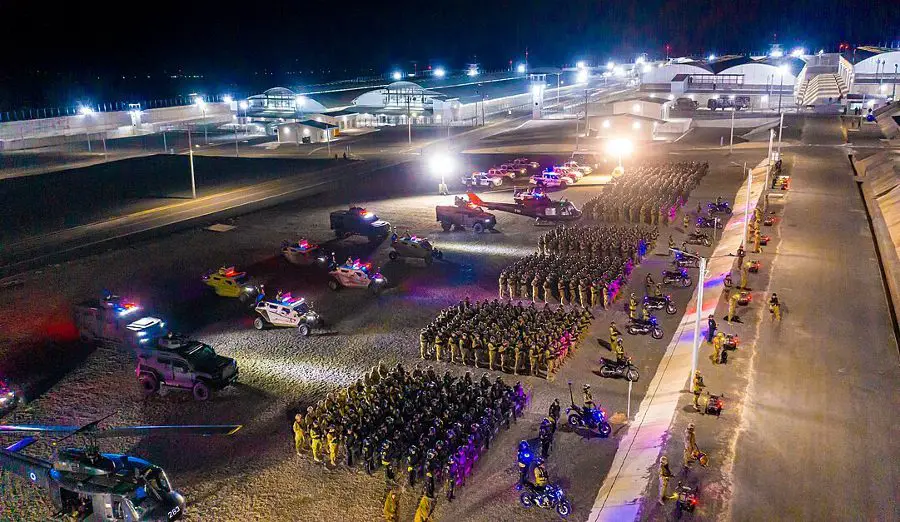
The Salvadoran government built the Terrorism Confinement Center (CECOT) as part of its response to the massive gang crackdown. The prison opened in 2023 to accommodate thousands of gang members already convicted.
CECOT has a reported capacity of 40,000 inmates and includes extensive security measures designed to prevent escapes and maintain strict control. The facility primarily houses members of El Salvador’s major gangs.
Beyond its role as a prison, CECOT has become a powerful symbol of President Nayib Bukele’s security strategy and tough approach toward gangs, attracting widespread international attention.
To learn more about the facility, its security features, inmates, conditions, and role in El Salvador’s prison system, visit our “Terrorism Confinement Center prison CECOT“ page.
Prison Strategy
Another key part of El Salvador’s security strategy was cutting communication between imprisoned gang members and those on the streets. Before 2019, inmates could use prison pay phones, while cellular signals were also available inside prisons.
Under the Bukele administration, authorities removed pay phones from prisons and blocked cell phone signals. The goal was to stop imprisoned gang leaders from communicating with members on the outside or giving them orders.
Prison visitation rules also changed significantly. Gang members who had previously been allowed to receive visitors could no longer do so, further limiting communication between incarcerated gang members and people outside the prisons.
Authorities also ended the practice of separating prisons according to gang affiliation. Rival gang members could now be held in the same prisons and cells, breaking a system that had reinforced gang control inside prisons.
El Salvador’s Homicide Rate Collapse
El Salvador’s security has undeniably improved under the current administration. Evidence of this improvement is found in the country’s yearly homicides, homicide rate per 100,000 people, and in the days with zero homicides.
In 2015, El Salvador recorded 6,656 homicides, equal to a rate of 106.3 per 100,000 inhabitants. It was one of the country’s deadliest years, with no day ending without a homicide.
By 2019, annual homicides had fallen to 2,398, while the homicide rate dropped to 35.8 per 100,000 inhabitants. The country also registered six days without homicides during the year.
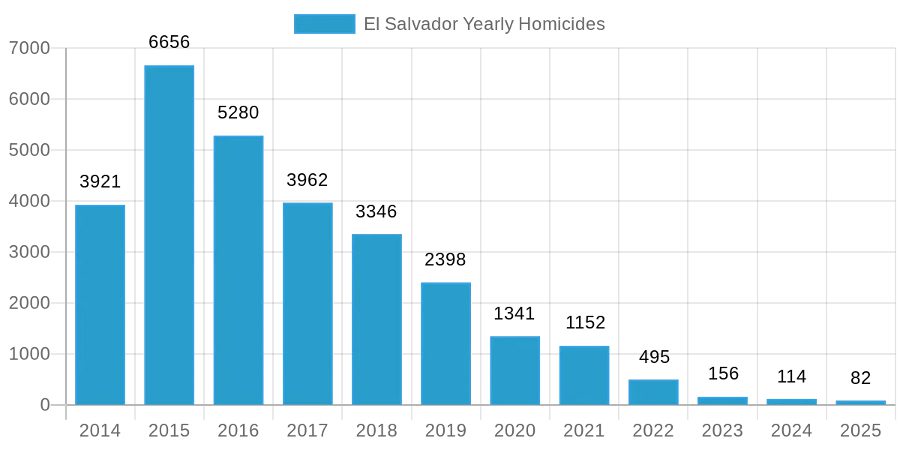
The decline accelerated by 2022, when El Salvador recorded 495 homicides and a rate of 7.8 per 100,000 inhabitants. Even more notable, the country finished 168 days without a homicide.
By 2025, the numbers had fallen even further. El Salvador recorded only 82 homicides, producing a historic rate of 1.36 per 100,000 inhabitants and reaching 305 homicide-free days.
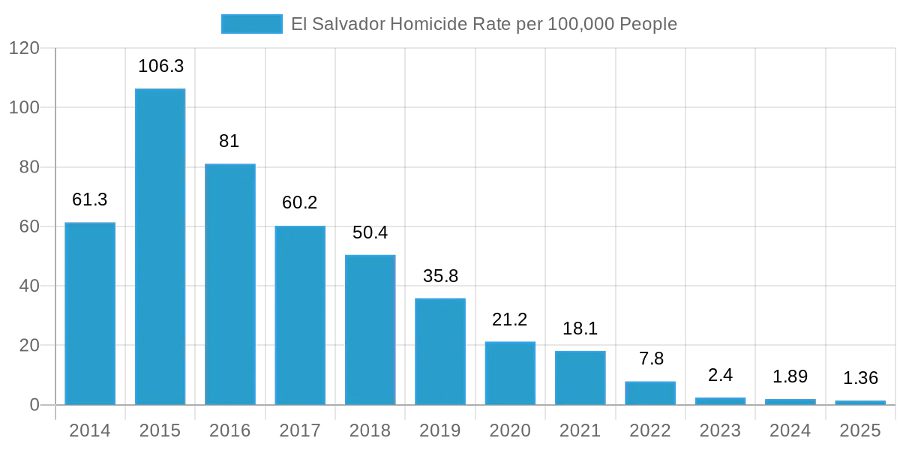
Overall, annual homicides dropped by nearly 99 percent between 2015 and 2025. At the same time, homicide-free days went from zero to 305, highlighting the dramatic change in El Salvador’s security situation.
Central America and Latin America.
Since 2023, El Salvador has reported the lowest homicide rate in Central America and Latin America, marking a dramatic change for a country that once ranked among the most violent in the region.
The country maintained that position in 2024 and 2025 as homicides continued falling. In 2025, El Salvador recorded a homicide rate of just 1.36 per 100,000 inhabitants.
These figures placed El Salvador well below the homicide rates reported by neighboring Central American countries and other Latin American nations, reinforcing the scale of the country’s security transformation.
Government Methodology for Counting Homicides
El Salvador’s official homicide statistics from 2019 to 2026 do not include alleged gang members killed during confrontations with Salvadoran security forces, an important detail when evaluating the government’s reported homicide totals and rates.
Even if these deaths were added to the official figures, El Salvador’s homicide rate would still rank among the lowest in Latin America. However, the exact rate would vary depending on the year.
Everyday Life Today: Living in a Safer El Salvador
Everyday life in El Salvador has changed dramatically. Once defined by fear and insecurity, the country is now widely recognized for its improved security and the greater freedom people experience in their daily lives.
Families gather in public parks without fear, children play into the evening, and businesses remain open late—visible reminders of a society reclaiming its public spaces.
Nightlife has also experienced a revival. Restaurants, bars, and entertainment venues remain active after dark, giving Salvadorans more opportunities to enjoy places and activities that insecurity once made difficult or dangerous.
Tourist zones continue to welcome travelers with increased safety. Visitors walk freely through historic centers, coastal routes, and previously insecure neighborhoods.
Salvadorans living abroad often notice the difference when they return home. Many find a country where traveling between communities is easier and the invisible boundaries once imposed by gangs have largely disappeared.
The changes go beyond homicide statistics. Salvadorans have greater freedom to work, study, travel, visit relatives, operate businesses, and enjoy their communities without security dominating many of their everyday decisions.
El Salvador’s international image has changed along with its security situation. Once widely associated with gangs and extreme violence, the country is increasingly recognized for its dramatic security improvements and historically low homicide rates.
International Recognition and Perception
El Salvador’s security transformation has captured global attention. International media once branded the country the “most dangerous,” but now highlight its shift to “one of the safest in Latin America.”
Global news coverage now emphasizes the security improvement, showcasing families in public spaces, bustling nightlife, and thriving businesses—contrasting the fear-driven narratives that once defined Salvadoran life.
Tourism has increased as visitors feel more secure exploring cultural sites, beaches, and cities. International arrivals continue to grow, solidifying the country’s status as a safe travel destination.
El Salvador’s reputation has changed permanently. The country is now defined by safety, positioning El Salvador as an example of transformation in Latin America’s ongoing fight against violence.
Challenges and Skepticism
El Salvador’s security turnaround impresses many, but it also sparks questions. Critics warn that extraordinary crackdowns raise concerns about rights, institutions, and the sustainability of this model.
Human rights organizations highlight due process violations during states of exception. Reports of arbitrary arrests and limited legal protections spark skepticism about the government’s aggressive approach.
The heavy reliance on military deployments and mass incarceration raises risks. Without strengthening civilian institutions, security could collapse if these hardline measures weaken or lose funding.
Experts question whether long-term peace requires broader reforms—such as judicial independence, educational access, and job creation—rather than relying solely on punitive, force-driven strategies.
Skeptics argue that this safety model cannot endure without systemic change. Proper stability depends on addressing poverty and inequality, root causes that fuel criminal structures over generations.
Yes, El Salvador feels safer than ever. However, people still wonder if the government can transition from emergency crackdowns to long-term democratic stability.
Security in El Salvador
El Salvador’s security transformation has been remarkable. Communities once dominated by gangs have experienced a dramatic decline in lethal violence. At the same time, Salvadorans have gained greater freedom to travel, work, and enjoy public spaces.
The security gains have changed daily life and reshaped the country’s international image. However, they have also come at the cost of extraordinary measures, particularly the prolonged State of Exception and its restrictions on constitutional rights.
Residents describe the change as impresive. Parks, businesses, and streets once avoided after dark are now full of life, giving Salvadorans a sense of freedom.
Newcomers and returning Salvadorans feel the difference immediately. What was once unthinkable—walking safely at night, exploring neighborhoods—has become an everyday reality across the country.
Tourists and investors alike notice the same security improvements, reshaping El Salvador’s reputation abroad. Headlines highlight safety, reversing decades of coverage focused only on violence.
This transformation is more than statistics; it’s lived experience. El Salvador has transformed fear into confidence, establishing security as the cornerstone of its new identity and future growth.