 Minister of Defense of El Salvador Merino Monroy.
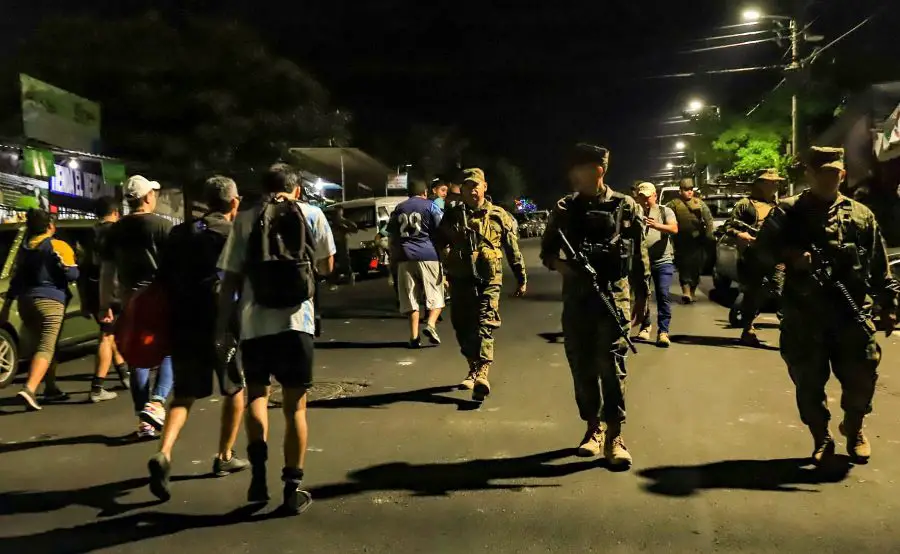
 El Salvador’s Legislative Assembly approved the 55th consecutive extension of the state of Exception, prolonging the extraordinary measure that has restricted key constitutional rights since March 2022.
The motion passed with 57 votes from deputies of the Nuevas Ideas Party (NI), the National Conciliation Party (PCN), and the Christian Democratic Party (PDC).
Government lawmakers defended the extension, arguing that ongoing public security challenges justify maintaining the emergency framework. They stated that the initiative continues to address “unresolved issues” in the fight against organized crime.
The renewed decree takes effect on September 28 and remains in force until October 27, 2026.
The extension upholds the suspension of constitutional guarantees, such as the 72-hour limit on detention without a hearing and electronic communication privacy.
The State of Exception allows law enforcement to search electronic devices and communications without judicial authorization and to detain individuals for 15 investigative days before seeing a judge.
Human rights organizations and the Bukele’s opposition have raised concerns about the long State of Exception because of reports of abuses and human rights violations.
Also, opposition legislators assure that there is no justification for maintaining the suspension of constitutional rights.
Homicide Reduction
Based on the drastic homicide reduction, the Salvadoran Government supports maintaining the emergency security measure. El Salvador closed 2025 with 82 murders for a rate of 1.36 homicides per 100,000 inhabitants.
Furthermore, El Salvador ended 2022, 2023, 2024, and 2025 with fewer homicides than Costa Rica, the nation that for the longest time was known as the safety standard in Central America.
Abuses and Human Rights Violations
Human rights organizations have claimed that many of the 90,000-plus arrested, during the State of Exception, were detained based on the appearance or social background of the detainees and not actual gang affiliation evidence, which violates the individual’s human rights.
Human Rights Watch has documented that hundreds of people with no connection to gangs have been unjustly detained, especially kids.
What’s Next
The State of Exception has the approval of the majority of Salvadorans. All surveys conducted since the security measure started have shown that it has a high approval rate.
The Legislative Assembly, controlled by New Ideas and allies, has supported the state of emergency since March 27, 2022. Based on comments by these legislators, it seems that the State of Exception will be extended throughout 2026.