 Terrorism Confinement Center.
 Few prisons have become internationally recognizable as quickly as El Salvador’s Terrorism Confinement Center CECOT. Better known only as CECOT, the massive facility has become one of the most visible symbols of the country’s transformation in public security.
Images from inside CECOT are striking. Hundreds of tattooed prisoners sit closely together under armed guard, surrounded by massive concrete cell blocks, high walls, surveillance systems, and watchtowers built for maximum security.
Today, CECOT attracts international attention for two different reasons. Supporters point to El Salvador’s dramatic reduction in gang violence, while human rights organizations raise concerns about detention conditions, due process, and alleged abuses.
- What Is CECOT?
- Why Did El Salvador Build CECOT?
- How Big Is CECOT?
- What Is Life Like Inside CECOT?
- Who Is Imprisoned at CECOT?
- Venezuelans Sent From the United States to CECOT
- CECOT and El Salvador’s Anti-Gang Strategy
- Human Rights Concerns Surrounding CECOT
- Why CECOT Has Attracted International Attention
What Is the Terrorism Confinement Center CECOT?
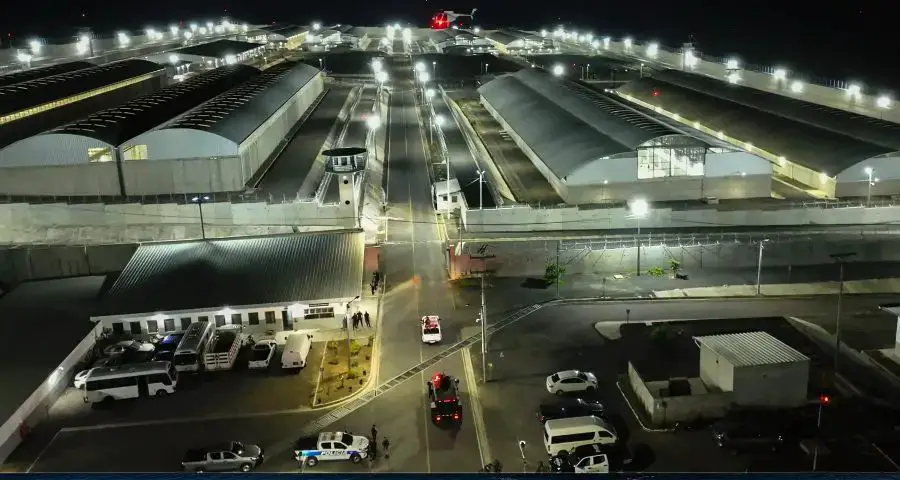
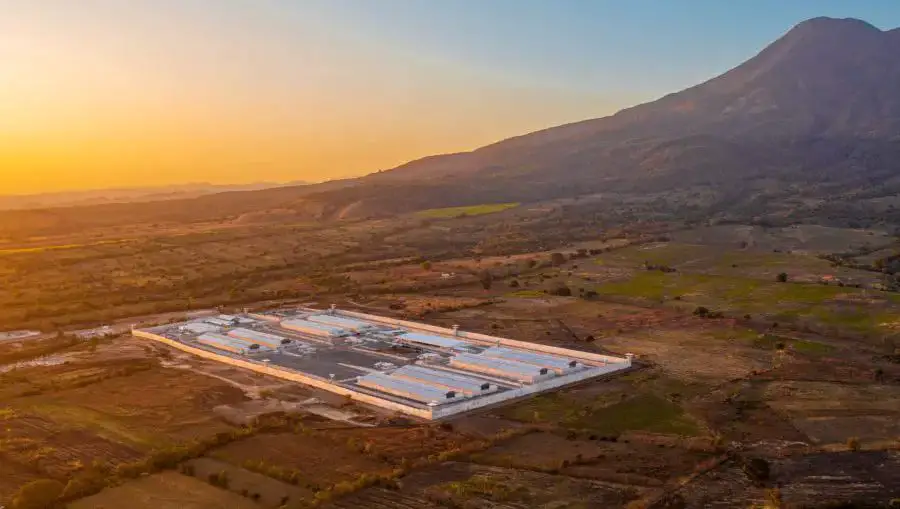
CECOT stands for Centro de Confinamiento del Terrorismo, or Terrorism Confinement Center. It is a maximum-security prison located in Tecoluca, in the central department of San Vicente, roughly 70 kilometers east of San Salvador.
The Salvadoran government built the prison during its large-scale campaign against MS-13, Barrio 18, and other gang structures. President Bukele inaugurated the facility in early 2023.
Authorities designed CECOT to hold as many as 40,000 prisoners, making it one of the largest prison facilities in Latin America. The complex occupies an isolated area far from major population centers.
The government didn’t build CECOT to expand El Salvador’s prison system. It created the massive facility to hold thousands of convicted gang members.
CECOT serves as a maximum-security prison for gang members, including those serving sentences for gang-related crimes. Being arrested under the state of exception, however, doesn’t automatically mean someone will end up at CECOT.
Many detainees remain in other prisons while their cases move through the courts. Those later convicted of crimes can ultimately serve their sentences at CECOT.
Why Did El Salvador Build CECOT?
To understand why CECOT exists, you have to understand the extraordinary influence gangs once held in El Salvador. For years, MS-13 and Barrio 18 controlled or contested communities throughout the country.
Gangs controlled daily life in many neighborhoods through extortion, threats, disappearances, and forced recruitment. They also limited where people could go, making something as simple as moving around their community dangerous.
For many residents, crossing from one gang’s territory into another could put them at serious risk, even when they were simply going to work, school, or visiting family.
El Salvador also experienced some of the world’s highest homicide rates during the worst years of the gang crisis. The violence affected daily life, businesses, public transportation, schools, and entire communities.
The major turning point came in March 2022. On March 26 alone, El Salvador recorded 62 homicides during a sudden surge in violence.
The next day, lawmakers approved a state of exception at the Bukele administration’s request. The measure gave authorities broader powers while suspending certain constitutional protections related to detention, legal assistance, and private communications.
Police and soldiers then began making arrests on a massive scale. By February 2023, when CECOT opened, authorities had already detained more than 62,000 suspected gang members and collaborators.
That created a practical problem: El Salvador needed somewhere to hold a rapidly expanding prison population. Existing prisons were already overcrowded before tens of thousands of additional detainees entered the penitentiary system.
CECOT became the government’s answer. When construction was announced in June 2022, President Bukele said the country needed a new prison capable of holding the large number of people captured during what his administration calls the “War Against Gangs.”
The prison also carried a broader message. Rather than treating CECOT as another correctional facility, the government presented it as a central component of its strategy to permanently dismantle gang structures.
How Big Is CECOT?
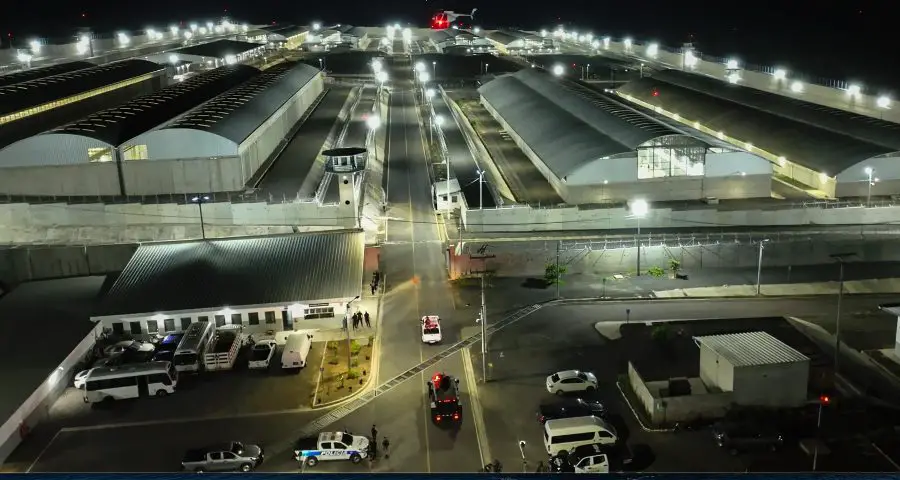
Size is one reason CECOT attracts so much attention. The government says the prison can accommodate 40,000 inmates across eight large modules designed to operate under maximum-security conditions.
The sprawling complex also contains administrative facilities, security infrastructure, an armory, equipment storage areas, and multiple layers of security separating prisoners from the outside world.
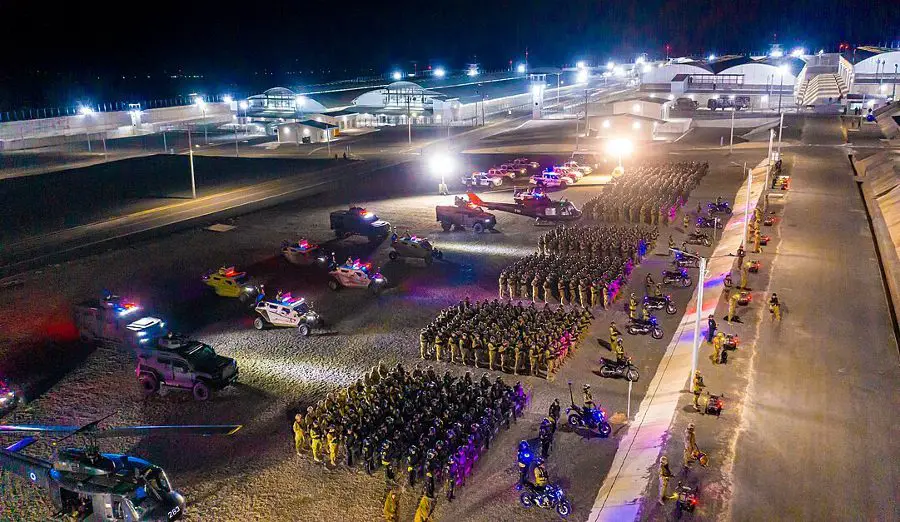
According to information released when CECOT opened, 600 soldiers and 250 National Civil Police officers were assigned to provide external security. Prison guards handle security and operations inside the facility.
The perimeter adds another layer. The prison stands in an isolated location and incorporates walls, fencing, surveillance equipment, watchtowers, and other security measures intended to prevent escapes and unauthorized communication.
What Is Life Like Inside CECOT?
Life inside CECOT bears little resemblance to an ordinary prison environment. The Salvadoran government built the facility around maximum security and confinement, with officials describing those sent there as highly dangerous gang members.
Images released by authorities show large communal cells packed with rows of metal bunks, toilets, washing areas, and little personal space. Prisoners generally sleep without mattresses or sheets, while artificial lights remain on around the clock.
Daily life follows strict rules. Meals arrive inside the cells, guards and cameras constantly monitor the cell blocks, and prisoners have little control over how they spend most of their day.
Life outside the cells is extremely limited. Salvadoran authorities have told visiting journalists that prisoners may leave for about 30 minutes each day, usually to exercise or participate in religious activities under close supervision.
CECOT also offers little in the way of rehabilitation. Human Rights Watch and Cristosal have reported limited educational and recreational opportunities, with former detainees describing long periods spent confined inside their cells.
Contact with the outside world is heavily restricted as well. Human Rights Watch has reported that prisoners have been denied communication with relatives and lawyers, while regular family visits aren’t allowed at the maximum-security facility.
Privacy is nonexistent. Guards and surveillance cameras monitor prisoners throughout the facility, while toilets and washing areas sit inside communal cells, exposed to other inmates and people moving through nearby corridors.
Human rights organizations have strongly criticized these conditions. Amnesty International has described conditions at CECOT as inhumane, while Human Rights Watch and Cristosal have documented concerns involving food, health care, sanitation, and hygiene.
The Salvadoran government takes a very different position. It presents CECOT and its wider security strategy as necessary tools for confronting gangs and maintaining the dramatic improvements in public security seen in recent years.
Those competing views have placed CECOT at the center of an international debate over security and human rights, making the mega-prison one of El Salvador’s most closely watched institutions.

Who Is Imprisoned at CECOT?
CECOT initially became known for housing thousands of alleged or convicted members of MS-13 and Barrio 18 transferred from other Salvadoran prisons during the government’s anti-gang campaign.
The first major transfer occurred in February 2023, when approximately 2,000 prisoners arrived at the facility. Another 2,000 followed in March, bringing the early population to about 4,000.
The number of prisoners at CECOT continued to grow afterward, but the government doesn’t regularly publish updated population figures. That makes one distinction important: CECOT can hold up to 40,000 prisoners, but that doesn’t mean 40,000 people are currently held there.
CECOT’s population also changed in character when El Salvador began accepting people transferred from the United States, turning a prison created for El Salvador’s anti-gang campaign into part of an international immigration and security debate.
Venezuelans Sent From the United States to CECOT
CECOT entered a new chapter in March 2025, when the United States transferred Venezuelan nationals to El Salvador under an agreement between the Trump and Bukele administrations.
In March and April, the United States sent 252 Venezuelans to CECOT. U.S. authorities accused many of connections to the Venezuelan gang Tren de Aragua, though the basis for those allegations became heavily disputed.
Human Rights Watch and Cristosal later reported that roughly half of those Venezuelans had no criminal history and only a small percentage had U.S. convictions for violent or potentially violent offenses.
The Venezuelans remained at CECOT for several months. On July 18, 2025, all 252 were released and sent to Venezuela as part of an agreement involving Americans detained by the Venezuelan government.
Their detention significantly expanded international scrutiny of CECOT because the facility was no longer only part of El Salvador’s domestic security policy. It had become connected to U.S. immigration enforcement and regional diplomacy.
CECOT and El Salvador’s Anti-Gang Strategy
CECOT is closely tied to El Salvador’s broader state of exception. Lawmakers first approved the emergency measure in March 2022 and have continued extending it since then.
By September 2026, authorities had arrested more than 93,000 alleged gang members under the crackdown. The government credits its security strategy with dramatically reducing gang violence and improving public safety across the country.
Official figures also show a dramatic decline in homicides. El Salvador’s homicide rate fell from 106.3 per 100,000 inhabitants in 2015 to 1.3 in 2025.
For many Salvadorans, the change is experienced at street level. Communities once associated with gang control have changed substantially, and restrictions imposed by criminal groups have disappeared from many neighborhoods.
CECOT therefore represents something larger than prison infrastructure. Within the government’s security model, it serves as a physical guarantee that imprisoned gang members can’t return to communities where their organizations previously operated.
Human Rights Concerns Surrounding CECOT
El Salvador’s security strategy has drawn substantial criticism from Salvadoran and international human rights organizations. Their concerns include arbitrary arrests, due process violations, prison conditions, deaths in custody, and limited access to legal representation.
The Inter-American Commission on Human Rights has also questioned the lack of transparency surrounding CECOT and the broader state of exception. The commission has pointed to limited public information about the prison, including how authorities planned and built it.
Scrutiny increased in 2025 after the United States began sending Venezuelan migrants to CECOT. Their detention brought international attention to conditions inside the prison and questions about the detainees’ legal rights.
Human Rights Watch and Cristosal later investigated how Venezuelan detainees were treated while at CECOT. They documented allegations of physical abuse, prolonged isolation, inadequate medical care, poor sanitation, insufficient food, and other mistreatment.
The organizations described the abuses they documented as systematic. Their investigation included interviews with 40 former detainees, as well as relatives and lawyers, and examined medical evidence, documents, photographs, and open-source material.
Other international organizations have raised similar concerns. Amnesty International has criticized El Salvador’s detention policies, while United Nations experts have called on the government to respect human rights as it fights crime.
Critics also argue that CECOT focuses on punishment instead of rehabilitation. Prisoners spend most of their days inside communal cells, with little freedom of movement, few activities, and limited contact with the outside world.
The Salvadoran government sees things differently. Officials say tough measures were necessary to dismantle gangs that controlled communities, extorted residents, committed killings, and terrorized Salvadorans for decades.
The government also points to the country’s dramatic decline in homicides and gang activity as evidence that its strategy has worked where previous security policies failed to protect the population.
These competing perspectives sit at the heart of the debate over CECOT. The prison raises a difficult question: how far can a government go to fight organized crime while still protecting detainees’ legal and human rights?
That tension has turned CECOT into one of the world’s most closely watched prisons—a symbol of El Salvador’s security transformation for supporters and a major human rights concern for its critics.
Why CECOT Has Attracted International Attention
CECOT has become one of El Salvador’s most internationally recognizable institutions. Videos and photographs from the facility have circulated worldwide, while politicians and security officials from other countries have shown interest in El Salvador’s approach.
CECOT’s influence is already spreading beyond El Salvador. In January 2026, President Bukele traveled to Costa Rica for the opening of a new maximum-security prison partly inspired by the Salvadoran model.
CECOT has become more than just a prison. Governments facing organized crime are studying El Salvador’s security strategy, while human rights groups point to the facility when raising concerns about mass incarceration.
Terrorism Confinement Center CECOT
Few places show how much El Salvador’s security situation has changed in recent years quite like CECOT. The government built the massive prison after decades of gang violence, as it pushed to dismantle the criminal groups that had controlled many communities.
The results of the broader security campaign are visible in sharply lower official homicide figures and the loss of territorial control once exercised by gangs across many Salvadoran communities.
At the same time, CECOT remains tied to unresolved questions about due process, transparency, prison conditions, independent oversight, and the treatment of people detained under extraordinary security measures.
CECOT continues attracting attention far beyond El Salvador. It’s more than a mega-prison in rural San Vicente; it has become a defining symbol of the country’s new security era.