 Music from El Salvador.
Music in El Salvador is more than entertainment—it’s an expression of history, emotion, and national identity. From the ancestral sounds of indigenous drums to the modern rhythms of reggaetón and cumbia, Salvadoran music reflects the country’s rich musical heritage.
El Salvador’s music is a captivating blend of indigenous, American, European, and African influences. From traditional folk melodies to modern genres, the music from El Salvador reflects the country’s rich history and cultural diversity.
Salvadoran music has a diverse range of genres, including folk, Xuc, marimba, cumbia, hip-hop, salsa, merengue, reggaeton, and rock.
The History of Music in El Salvador
The story of Salvadoran music stretches back well before the Spanish arrived. Pre-Columbian communities created instruments from materials available around them, using music as part of ceremonies, celebrations, and everyday cultural life.
When Spanish Colonization arrived, new instruments like the guitar and violin blended with native rhythms, giving birth to hybrid forms of folk music.
But Salvadoran musicians didn’t simply copy what they heard. They made those sounds their own, blending them with local traditions and shaping music that reflected Salvadoran culture and everyday life.
By the late 1800s, recordings brought European, American, Mexican, and South American music to El Salvador. Local marimbas and town bands soon put their own spin on popular songs.
In the early 1900s, marimba groups, municipal bands, and orchestras became an important part of the country’s music scene. Radio, recordings, travel, and later television introduced even more sounds, helping shape the diverse Salvadoran music heard today.
Traditional Salvadoran Music
Traditional Salvadoran music can’t be reduced to a single rhythm. The country’s musical heritage includes dances, marches, folk compositions, marimba traditions, regional styles, and music connected with community celebrations.
Among these traditions, xuc holds a particularly distinctive place because musicians can trace its creation to Salvadoran composer Francisco “Paquito” Palaviccini and the city of Cojutepeque during the 1940s.
Xuc: A Distinctly Salvadoran Rhythm
Francisco Palaviccini created and popularized xuc, mixing Salvadoran sounds with other musical influences. His 1942 composition “Adentro Cojutepeque” helped introduce the rhythm, whose name likely came from the “xuc, xuc” sound of the traditional juco instrument.
Palaviccini also wrote songs inspired by Salvadoran places and celebrations, including “Santa Ana,” “Cocotero Sonsonateco,” and “Carnaval de San Miguel.”
Today, xuc remains part of folkloric dances, festivals, civic events, and cultural programs. More than just a musical style, xuc has become a sound closely tied to Salvadoran culture, tradition, and national identity.
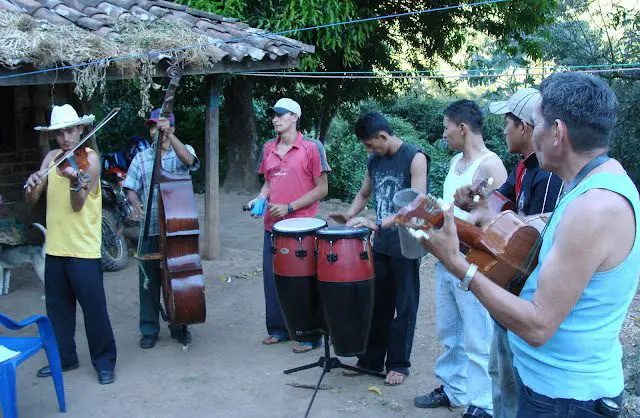
Chanchona Music
Travel into eastern El Salvador and another musical tradition enters the picture: chanchona music. The name refers both to a large stringed bass instrument and, commonly, to ensembles built around its deep sound.
The chanchona typically has four strings and is plucked with the fingers rather than played with a bow. Traditional groups may combine it with violins, guitars, harmonicas, and percussion instruments.
This music has particularly strong associations with rural communities in eastern El Salvador. Its lively, dance-friendly character makes it quite different from the polished sound of the country’s large tropical orchestras.
A famous Chanchona group worth knowing is “Los Hermanos Lovo,” this musical group immigrated from Morazan and settled in the Washington, D.C., area. Click here to view a Smithsonian video about this Salvadoran group.
Marimaba: Folkloric Music of El Salvador
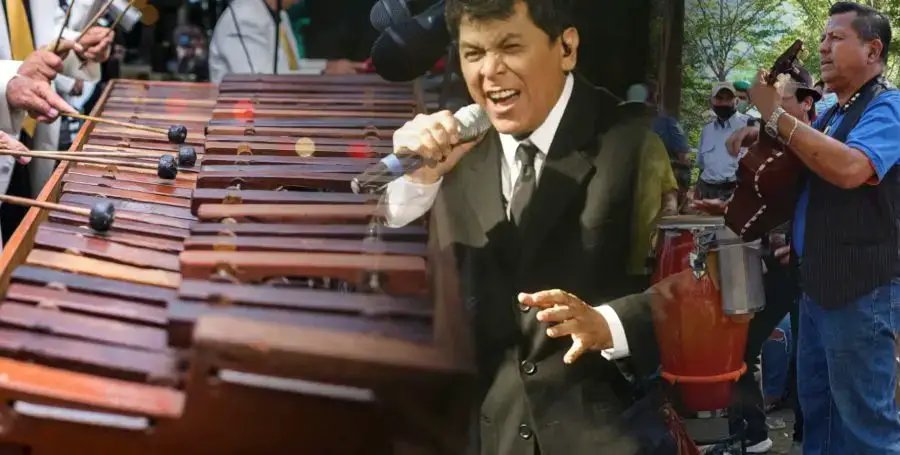
The marimba has long been part of El Salvador’s traditional music and folkloric dances. By the early 1900s, marimba groups were well established, including Santa Ana’s Marimba Cuscatleca, founded in 1910. Marimba music became especially popular during the 1920s and 1930s.
The marimba de arco, or bow marimba, also survived among rural communities with Indigenous cultural roots in western El Salvador.
Songs such as “El Carbonero” and “El Torito Pinto” offer a good introduction to this traditional sound. Marimba Centroamericana also helped bring Salvadoran marimba music to audiences at home and abroad.
Another early marimba band was Marimba Atlacatl, founded by Francisco Antonio Beltran in 1917. He toured the world in the 1930s, and in 1935, won an award, presented by the Prince of Wales and his fiancée Wallis Simpson, at the Palm Beach Casino on the Azul Coast of France. Wikipedia.
Salvadoran Tropical Music “Cumbia”
Few rhythms have become as closely connected with Salvadoran parties as cumbia. The genre originated outside the country, but Salvadoran musicians transformed it into a major part of local popular culture.
By the mid-1900s, cumbia was starting to catch on across El Salvador. Musicians like Rafael “Lito” Barrientos helped spread the sound, while Colombian records and Salvadoran versions brought cumbia into homes through the radio.
Salvadoran orchestras eventually developed their own approach. Big ensembles, brass sections, percussion, keyboards, energetic singers, and dance-oriented arrangements helped turn cumbia into a staple of fiestas patronales, carnivals, weddings, and family parties.
Groups like Orquesta Hermanos Flores have kept this musical tradition alive for generations. The band got its start in the 1960s and became part of El Salvador’s long love affair with tropical music.
For many Salvadorans, these songs bring back more than musical memories. A familiar cumbia can take you back to childhood parties, hometown festivals, Christmas celebrations, weddings, neighborhood dances, or family gatherings with relatives visiting from abroad.
Salvadoran Tropical music, which includes Cubias, Salsa, and Merenge, is a staple in Salvadoran culture. This type of tropical music is upbeat and gets played during national holidays and family gatherings or celebrations.
Some of the most popular Salvadoran music groups famous internationally are La Orquesta San Vicente, Los Hermanos Flores, El Grupo Bravo, La Maquina, and Banda Laser.
Popular Music Genres
Salvadorans listen to much more than traditional music and cumbia. Rock, pop, salsa, merengue, reggaeton, hip-hop, electronic music, regional Mexican music, ska, and alternative music all have their fans across the country.
That variety makes Salvadoran music difficult to place inside one convenient category. Someone might dance to an old tropical orchestra at a family gathering and listen to reggaeton or alternative rock the following morning.
Reggaeton and Urban
Reggaeton and other urban genres have become part of El Salvador’s modern music scene, especially among younger listeners. Salvadoran artists now mix local influences with musical trends popular across Latin America and the United States.
Streaming changed this landscape dramatically. Musicians no longer need national radio exposure before finding listeners. A Salvadoran artist can release music online and potentially reach audiences in Los Angeles, Washington, Houston, or Madrid almost immediately.
Modern and Popular Music
Today’s Salvadoran music scene pulses with diversity. Rock, pop, hip-hop, and reggaetón have gained strong followings, particularly among younger generations.
Artists such as Alvaro Torres, Marito Rivera, Pescozada, and Adrenalina, represent the old and the new wave of Salvadoran sound—mixing street poetry, digital beats, and tropical rhythms to tell contemporary stories.
Streaming platforms and social media have also given Salvadoran artists global reach, allowing them to blend heritage with international styles without losing their local voice.
Famous Salvadoran Musicians
Any introduction to Salvadoran music should include Francisco “Paquito” Palaviccini. His importance comes not simply from performing music but from creating xuc and composing pieces closely tied to Salvadoran cultural identity.
Palaviccini’s career included directing the Orquesta Internacional Polío and later forming Los Palaviccinis. He also directed the University of El Salvador’s orchestra during the early 1970s.
Another internationally recognized Salvadoran name is Álvaro Torres, whose romantic songs reached audiences far beyond El Salvador. His career demonstrates another side of Salvadoran music: artists participating successfully in the broader Latin American music industry.
El Salvador’s music scene goes far beyond a few famous names. Over the years, orchestra leaders, composers, singers, rock musicians, instrumentalists, DJs, and independent artists have all helped shape the country’s sound. Explore these artists individually, and you’ll discover just how diverse Salvadoran music really is.
Popular Salvadoran Songs
Salvadoran music has had numerous songs that have gained notoriety locally and internationally. The following songs are some of them!
1. Nada se Compara Contigo by Alvaro Torres
Alvaro Torres is a Salvadoran singer who has achieved great recognition outside El Salvador. He has been producing music since the 1980s. One of his prominent songs is” Nada Se Compara Contigo” or “Nothing compares to you.”
2. Mentiras by Marito Rivera
“Mentiras” or “Lies” is a song by Marito Rivera that will remain for immortality as one of the biggest hits in Salvadoran Music. Rivera’s music features the beauty of El Salvador, from its people to iconic archaeological sites.
3. El Sombrero Azul by Salsa Clave
“El Sombrero Azul” or “the Blue Hat” is an iconic song dedicated to Salvadoran culture featuring the people and iconic landmarks. The song is a dedication to those Salvadorans who work under the blue sky that serves as a hat to the country.
4. La Bala by Los Hermanos Flores
“La Bala” or “The Bullet” by Los Hermanos Flores is a popular song that gets played a lot during Christmas and other family gatherings. This classical song was created in the 1970s; since then has been copied by other artists.
5. La Chica de Humo by Rene Alonso
Rene Alonso is another Salvadoran singer that has produced long-lasting musical hits. Alonso started with the “Espiruto Libre” musical group and left to start his own group called “Rene Alonso y Su Banda Laser” one of his most recognized hit is “La Chica de Humo” or “the smoke girl.”
6. A mi me Gustan las Pupusas by Espíritu Libre
“A mi me Gustan las Pupusas” by the lost lasting group Espíritu Libre is a dedication to Pupusas, the national dish of El Salvador. The title of the song in English is “To me, I like Pupusas.”
The six songs listed above are just a small number of great music produced in El Salvador. The country has plenty of other musical groups or musicians that create or have created fantastic music.
Music in El Salvador and Culture
To understand Salvadoran music, you have to look beyond recordings. Music lives in fiestas patronales, school performances, civic events, religious celebrations, weddings, birthdays, carnivals, restaurants, bars, concerts, and neighborhood gatherings.
Town festivals offer especially good opportunities to experience that relationship. A celebration may include folkloric dancers during the day, a local band later, and a tropical orchestra keeping crowds dancing into the night.
The Carnaval de San Miguel provides one of the country’s clearest examples. Music and dancing form central parts of an event that has become closely identified with the city and eastern El Salvador.
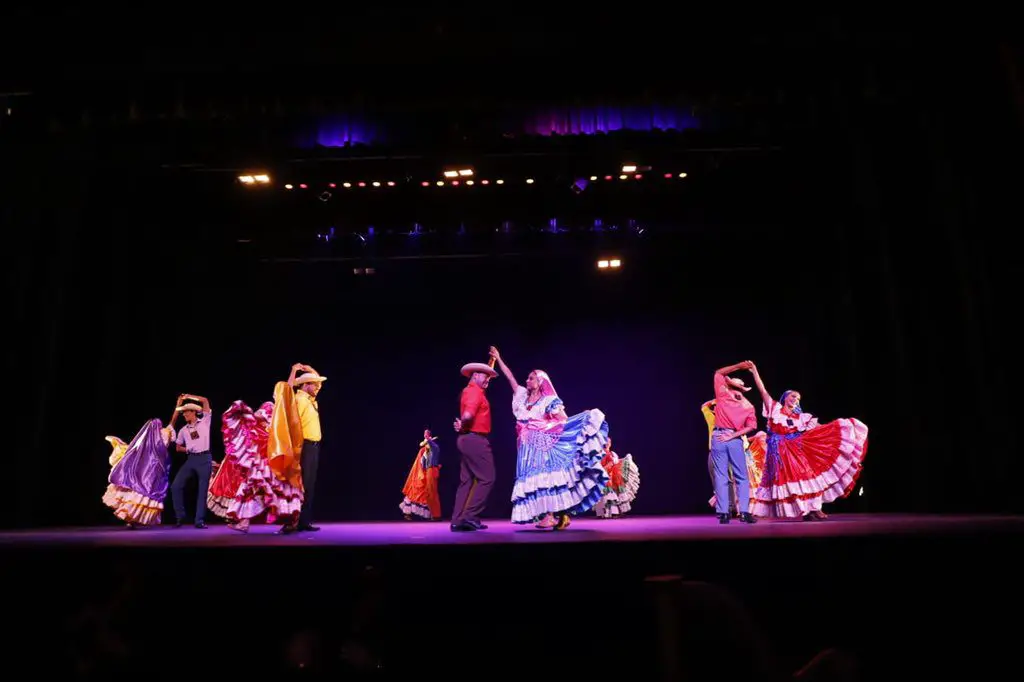
You can also encounter traditional performances during Independence celebrations and cultural events. Folkloric groups help keep older dances and musical compositions visible even as younger Salvadorans embrace international styles.
Music in El Salvador
Music in El Salvador tells a story you can hear. From traditional rhythms and marimba melodies to rock, cumbia, electronic music, and modern sounds, each generation adds something new to the country’s musical identity.
Salvadoran musicians have borrowed influences from different cultures, but they’ve also transformed those sounds into something distinctly local. Traditions such as xuc and folkloric music continue to connect today’s audiences with the country’s past.
You can experience Salvadoran music at festivals, patron saint celebrations, cultural events, concerts, and neighborhood gatherings. Many visitors discover that music often appears naturally alongside dancing, food, religious traditions, and community celebrations.
At the same time, Salvadoran music keeps evolving. Singers, bands, DJs, composers, and independent artists continue experimenting with new genres while older musical traditions remain part of the country’s cultural landscape.
To understand El Salvador beyond its beaches, volcanoes, and historic towns, listen to its music. The rhythms, songs, and artists reveal another side of the country—one shaped by history, creativity, community, and Salvadoran identity.
If you haven’t had the opportunity to listen to Salvadoran Music, head to YouTube or another music streaming service provider and listen to good Salvadoran music.