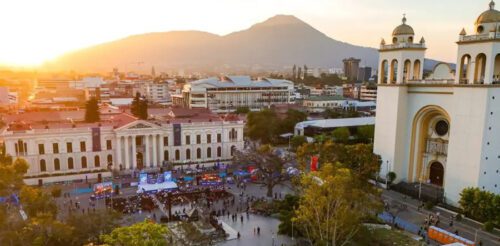
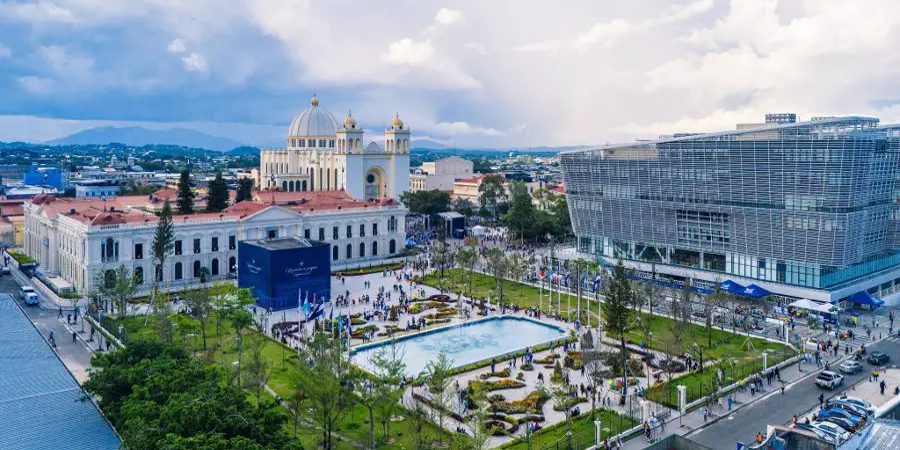
 Downtown San Salvador, El Salvador.
El Salvador’s economy has changed significantly over the past few decades, evolving from one driven mainly by agriculture into a more diversified economy supported by services, manufacturing, remittances, tourism, and growing investment.
Today, the Salvadoran economic performance is shaped by both long-standing industries and new development strategies.
In recent years, El Salvador has attracted global attention through major changes such as adopting Bitcoin as legal tender, improving public security, and investing in tourism and infrastructure. These efforts have raised the country’s international profile while also generating debate about their long-term impact on the economy.
Economy Overview
El Salvador has an economy that relies on private enterprise, international trade, services, and tourism as key drivers of growth.
The country uses the U.S. dollar as its official currency. This promotes oting monetary stability while maintaining strong economic ties with the United States and the Central American region.
In recent years, the economy of El Salvador has seen moderate but steady growth, driven by private consumption, tourism, construction, and remittances from Salvadorans living abroad.
Inflation has eased after the global price increases of 2022, while employment and business activity have remained relatively stable despite external economic challenges.
The economic outlook for El Salvador remains cautiously positive. International organizations expect continued GDP growth of about 2.5% to 3% annually.
However, long-term growth will depend on increasing productivity, attracting more private investment, strengthening exports, and managing public debt while maintaining macroeconomic stability.
Key Economic Indicators
Key economic indicators of El Salvador provide a snapshot of the country’s overall economic performance. These figures help measure economic growth, income levels, employment, inflation, and poverty across the nation.
The most recent annual data from the World Bank shows that in 2025, El Salvador recorded a nominal GDP of $36.71 billion, a GDP per capita of $5,766.70, and a real economic growth of 3.9%.
As of June 2026, El Salvador’s annual inflation rate stood at 2.76%, which is one of the lowest in Central America.
According to the Salvadoran government’s Multipurpose Household Survey, the country’s unemployment rate was 4.7% in 2025, suggesting that the labor market remained relatively stable.
The same survey found that 22.5% of the population lived in monetary poverty, while 7.7% lived in extreme poverty. The BCR survey figures show that many Salvadorans still face challenges related to income, education, housing, and access to basic services.
Income levels vary considerably across the country. Average household monthly income reached $763.81, including $888 in urban areas and $556 in rural communities.
Individuals with 10 to 12 years of schooling earned an average of $434.81 monthly, while those with 13 or more years of education averaged $747.33.
Major Industries
The Salvadoran economy is primarily service-based, with manufacturing, agriculture, construction, tourism, and financial services playing important roles. While agriculture was once the country’s dominant economic sector, services now account for the largest share of GDP and employment.
The major industries of El Salvador include:
Services: The largest sector of the economy, including retail and wholesale trade, transportation, telecommunications, healthcare, education, and professional services.
Manufacturing: Produces textiles and apparel, food and beverages, plastics, chemicals, pharmaceuticals, paper products, and metal goods. The textile and garment industry is one of the country’s largest exporters.
Agriculture: Produces coffee, sugarcane, corn, beans, rice, fruits, vegetables, and livestock. Coffee remains one of El Salvador’s most recognized agricultural exports.
Financial Services: Includes commercial banking, insurance, investment services, and digital financial technologies. Dollarization has contributed to a stable banking sector.
Construction: Driven by residential housing, commercial projects, public infrastructure, and private investment. The sector has expanded in recent years due to government infrastructure initiatives.
Tourism: One of the fastest-growing industries, supported by improved public security, Surf City development, archaeological sites, volcanoes, beaches, and cultural attractions.
Business Process Outsourcing (BPO): Call centers, customer support, shared services, and IT outsourcing serve clients primarily in the United States and other international markets.
Energy: Generates electricity from geothermal, hydroelectric, natural gas, solar, wind, and biomass sources. El Salvador is a regional leader in geothermal energy production.
Commerce: Retail and wholesale trade make up a significant portion of economic activity, supported by strong domestic consumption and remittances.
Agriculture, Manufacturing, and Services
El Salvador’s economy is built around three main sectors: services, manufacturing, and agriculture. The services sector is the country’s largest economic driver, while manufacturing is a major source of exports. Agriculture also plays an important role by supporting rural jobs and producing many of the country’s key crops.
The services sector is the largest part of El Salvador’s economy, generating more than half of the country’s GDP and employing over half of its workforce.
It includes a wide range of industries, such as retail and wholesale trade, transportation, telecommunications, financial services, tourism, healthcare, education, and professional and business services.
Manufacturing is one of El Salvador’s key economic sectors, contributing about 20% of the country’s GDP and providing thousands of jobs.
The Manufacturing sector produces textiles and apparel, food and beverages, plastics, chemicals, pharmaceuticals, paper products, and metal goods. Among these industries, textiles and garments remain one of the country’s largest export earners.
Agriculture contributes a small percentage of the country’s GDP but supports a much larger share of rural employment. Most rural employment is informal.
Key agricultural products include coffee, sugarcane, corn, beans, rice, fruits, vegetables, and livestock. Coffee continues to be one of El Salvador’s most recognized agricultural exports despite the sector’s smaller economic share.
Together, the services, manufacturing, and agriculture sectors form the backbone of El Salvador’s economy. Services generate most of the country’s economic activity, manufacturing supports exports, and agriculture remains vital for food production and jobs in rural communities.
Tourism’s Economic Role
Since 2019, tourism has become one of El Salvador’s fastest-growing industries and a major driver of the country’s economy. Over this time frame, international visitor arrivals have increased significantly.
The Salvadoran government has focused on improving infrastructure along the Pacific coastline, attracting visitors to the country’s world-class Pacific beaches.
At the same time, cultural attractions, historic towns, archaeological sites, and ecotourism destinations have expanded the range of experiences available to travelers.
The tourism industry, part of the service sector, supports thousands of jobs in hotels, restaurants, transportation, tour operations, and other local businesses.
As more visitors travel to the country, communities benefit from increased spending that helps support local economies.
Tourism has also helped drive investments in infrastructure, including airport improvements, better roads, upgraded public spaces, and expanded digital connectivity.
These improvements make it easier for visitors to explore the country while also enhancing daily life for residents and supporting long-term economic growth.
Exports and Imports
Exports and imports play an important role to the Salvadoran economy. The country exports between $6.3 billion and $6.6 billion in goods each year to markets around the world.
Central America is El Salvador’s largest export market, receiving about half of all Salvadoran exports. The United States is the country’s largest single-country destination, accounting for roughly 35% of total exports.
El Salvador imports far more goods than it exports. As of June 2026, the country recorded a trade deficit of about US$5.92 billion, with imports exceeding exports by approximately 174%.
Remittances
Remittances play a major role in El Salvador’s economy, providing financial support to hundreds of thousands of households across the country.
They account for a large share of the country’s GDP and are one of El Salvador’s most important sources of income. In many years, remittances have contributed more to the economy than the country’s traditional exports.
In 2025, El Salvador received $3.6 billion more in remittances than it exported. This trend of remittances over exports continues in 2026.
The money sent home helps families pay for everyday expenses like food, housing, education, and healthcare. It also boosts consumer spending, supports local businesses, and keeps money flowing through communities across the country.
Inflation and Cost of Living
Inflation and the cost of living have a direct impact on household budgets and the overall economy in El Salvador. While inflation has remained lower than in many Central American countries, rising prices continue to affect everyday expenses.
El Salvador ended 2025 with an annual inflation rate of 0.91%. By June 2026, inflation had increased to 2.76%, pushing up the cost of many goods and services, especially essential food items.
Higher inflation has raised the cost of the country’s Basic Food Basket from $252.08 at the end of 2025 to $259.95 by the end of June 2026.
That amount equals about 63% of El Salvador’s highest monthly minimum wage of $408.80, showing how food costs consume a large share of many workers’ incomes.
Inflation hits hardest at the dinner table. Rising prices in the basic food basket are squeezing household budgets, forcing families to stretch their incomes. At the same time, wages fail to keep up.
Wages remain low by regional standards, with many surviving on the minimum salary. This reality exacerbates income inequality among most Salvadorans.
Currency
The U.S. dollar is El Salvador’s official currency. Using the dollar provides price stability, makes international trade easier, and eliminates the need to exchange currencies.
Dollarization helps attract foreign investment by reducing exchange rate risk and making financial transactions more predictable.
However, because El Salvador uses the U.S. dollar, it cannot set its own monetary policy or adjust interest rates, leaving the economy more influenced by economic decisions made in the United States.
For many, Bitcoin is also considered a legal currency in El Salvador. In 2021, El Salvador shocked the world by adopting Bitcoin as legal tender, promising innovation, financial inclusion, and global relevance.
El Salvador’s adoption of Bitcoin attracted global attention and became one of the country’s most closely watched economic policies.
The government introduced several initiatives to promote cryptocurrency, including the proposed Bitcoin Bonds, also known as “Volcano Bonds,” to attract foreign investment and help finance infrastructure projects.
While the plan generated worldwide interest, many international investors remained cautious because of concerns about financial stability and the project’s long-term viability.
Organizations such as the IMF and the World Bank also warned that the policy could increase fiscal risks and make access to traditional financing more difficult.
Supporters believed Bitcoin would lower remittance costs, attract more tourists, encourage foreign investment, and expand financial inclusion.
However, adoption has been slower than many expected, with most Salvadorans continuing to rely on cash, debit cards, credit cards, and traditional banking services for everyday transactions.
Several years after becoming the first country to adopt Bitcoin as legal tender, El Salvador continues to draw both praise and criticism. While the policy has strengthened the country’s global profile, its long-term economic impact remains the subject of ongoing debate.
Credit Rating
El Salvador’s credit ratings reflect international agencies’ assessments of the country’s ability to repay its debt.
Higher ratings increase investor confidence, while lower ratings signal greater financial risk and may discourage investment. They also influence borrowing costs for the government.
As of June 2026, El Salvador has speculative-grade sovereign ratings of B− from Fitch and S&P and B3 from Moody’s. Moody’s has assigned a positive outlook, while Fitch and S&P maintain stable outlooks.
Economic Projections
The three major international organizations (IMF, WB, and ECLAC) and the Salvadoran Central Reserve Bank expect El Salvador’s economy to continue growing in 2026.
Throughout 2026, national and international institutions have projected economic growth for El Salvador ranging from 4.5% to 5%, generally pointing to continued expansion of the country’s economy.
The Salvadoran Central Reserve Bank has the strongest outlook, projecting growth between 4.5% and 5%. Its forecast suggests the economy could expand faster than the estimates released by international organizations.
The International Monetary Fund, the World Bank and ECLAC share similar expectations. All three institutions forecast 4.5% growth for El Salvador in 2026, placing their projections at the lower end of the Central Reserve Bank’s range.
While the projections differ, all four institutions expect economic expansion in 2026. The main difference is how quickly El Salvador will grow, with estimates spanning 1.1 percentage points from lowest to highest.
El Salvador Economy
El Salvador’s economy today demonstrates resilience. From the shocks of the pandemic to bold reforms, the country’s economic trajectory highlights both the challenges and opportunities shaping growth, stability, and social transformation.
Before the COVID-19 pandemic, growth averaged around 2–3%, a sluggish yet steady rate. Post-pandemic recovery is accelerating with tourism and remittances, while the economic outlook projects moderate stability, tempered by concerns over debt and global uncertainty.
El Salvador’s economy strikes a balance between resilience and risk, driven by remittances, tourism, and exports. Growth opportunities exist, but structural weaknesses continue to keep the country navigating between promise and uncertainty.
The country’s economic success will hinge on turning challenges into opportunities for long-term, inclusive development.