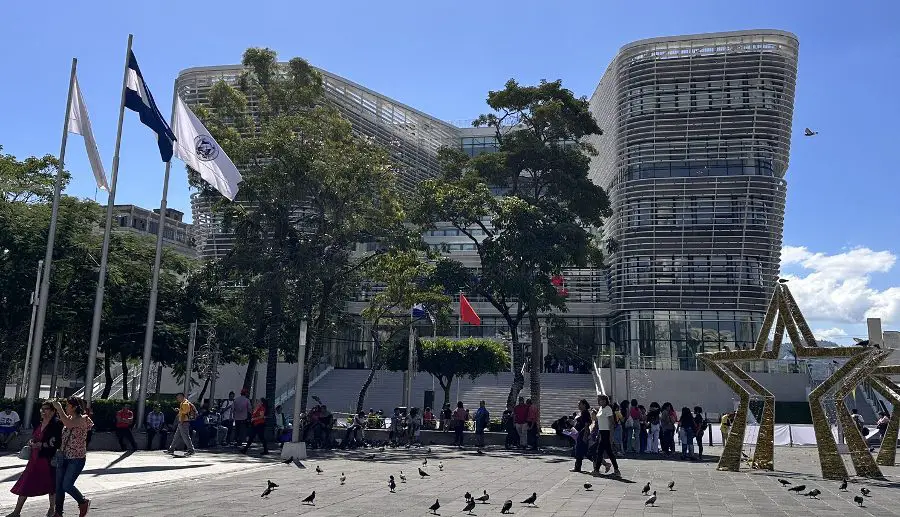
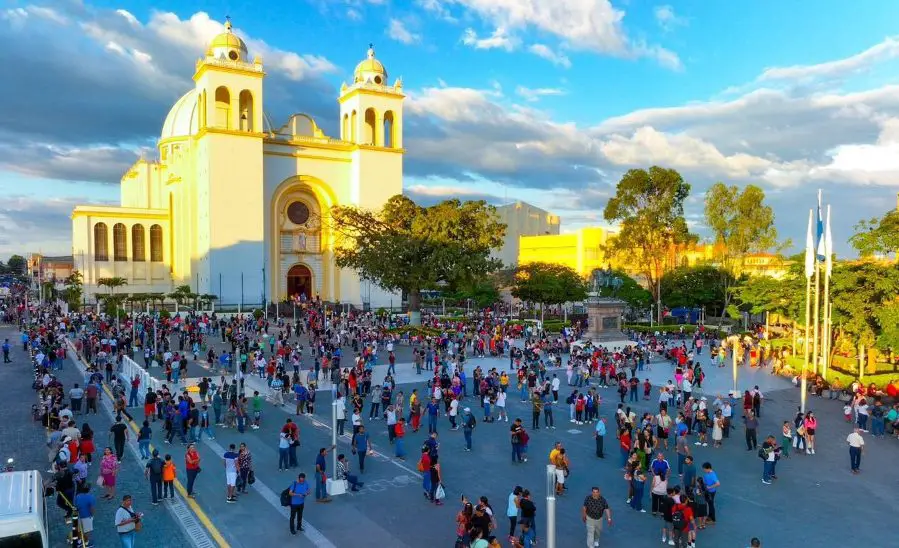
 El Salvador National Library (BINAES)
El Salvador’s legal currency is an important topic for travelers and business visitors to understand, as the country recognizes the U.S. dollar, Bitcoin, and the Salvadoran colón as legal tender.
Key questions to know the answer to include: What currency is primarily accepted? Can you use a credit card to make payments everywhere? Are ATMs available for cash withdrawals to foreign cards? Can I withdraw Bitcoin to cash at any location?
El Salvador’s adoption of Bitcoin as its legal currency has drawn global attention in recent years. But how exactly does Bitcoin as a legal currency impact residents and visitors?
The Official Currencies of El Salvador
The legal currencies of El Salvador are the U.S. dollar, the Salvadoran Colón, and Bitcoin. However, many experts argue that Bitcoin is no longer a legal tender in the country.
The primary currency used in El Salvador is the U.S. dollar, with Bitcoin far behind in adoption. While the Salvador Colón is recognized as legal tender, it is not in circulation.
The U.S. Dollar: The Every Day Currency
The U.S. dollar is the everyday currency used across El Salvador. It is the money used for earning, spending, saving, and measuring prices in daily life.
Pretty much everything in the country runs on U.S. dollars—from paying salaries and taxes to buying groceries, covering rent, or paying bills at markets, banks, and stores every day.
El Salvador adopted the dollar in 2001, replacing the colón and tying the nation’s financial system directly to the currency issued by the United States’ central bank and monetary authority.
For Salvadorans today, the dollar is simply money, the unit used to quote wages, set prices, and track household budgets without thinking about exchange rates in everyday life.
From the Salvadoran Colón to Dollarization
The Salvadoran colón once represented the nation’s monetary identity and served as the country’s official currency for decades. That changed in 2001, when the government led by Francisco Flores replaced the colón with the United States dollar, making the dollar El Salvador’s official currency.
As of the effective date of this law, the Central Reserve Bank of El Salvador, to the requirement of the banks of the system will exchange Colones in circulation for dollars. Article 4 of the Law of Monetary Integration.
The rationale was straightforward: curb inflation, stabilize prices, attract investment, and tie the nation’s financial system more tightly to the U.S. market—El Salvador’s largest trading partner and source of remittances.
But the trade-off was steep. Dollarization eliminated the Central Reserve Bank’s control over monetary policy. El Salvador could no longer devalue its currency to respond to shocks or print money to stimulate growth.
Economically, it reduced exchange-rate risk for businesses. Politically, it tethered the nation’s financial fate to Washington’s decisions.
Two decades later, the dollar remains the anchor of daily life—used for salaries, savings, and nearly all transactions. For most Salvadorans, “the dollar” replaced the colón without changing their economic reality.
Bitcoin (BTC): A Global Shock in 2021
El Salvador made global headlines in 2021 when President Nayib Bukele announced that the country would become the first in the world to adopt Bitcoin as legal tender.
Within days, the Legislative Assembly of El Salvador approved the Bitcoin Law, requiring businesses and government offices to accept Bitcoin alongside the United States dollar.
The policy was presented as a bold step toward financial independence and technological innovation. Officials argued that it would attract cryptocurrency investors, lower remittance costs, and expand financial access for Salvadorans without bank accounts.
At first, El Salvador drew global attention as it attempted to position itself as a digital-age pioneer. But the rollout quickly ran into difficulties.
The government’s official Chivo Wallet suffered repeated technical failures, and many businesses refused to accept Bitcoin despite the legal requirement.
International institutions, including the International Monetary Fund and the World Bank, warned that the policy carried significant financial and regulatory risks.
By 2025, surveys showed that more than 85% of Salvadorans had not used Bitcoin in the previous year, and less than 5% of remittances were processed through cryptocurrency. In everyday transactions, the U.S. dollar continued to dominate the economy.
In January 2025, the Salvadoran legislature amended the Bitcoin Law, removing the government’s obligation to accept Bitcoin and making its use optional for private businesses.
The change revived debate over whether Bitcoin still functions as a meaningful form of legal tender in the country.
Today, you can still pay in Bitcoin in some places. Still, acceptance is largely confined to tourist-oriented businesses catering to international travelers.
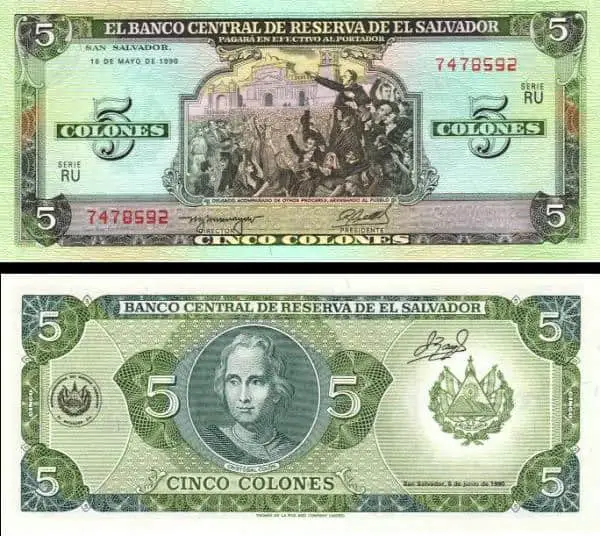
The Salvadoran Colón: El Salvador’s Original Bank Notes
The Salvadoran colón remains legal currency in El Salvador, but it has not circulated since 2001, when the United States dollar replaced it as the country’s primary medium of exchange.
Today, Salvadorans use only U.S. dollars in everyday transactions. The colón is no longer available through banks or businesses, and although it technically retains legal status, finding anyone willing to accept colón notes or coins is extremely unlikely.
Even so, the colón still carries historical and symbolic importance. Many Salvadorans keep old bills and coins as collectibles or reminders of the country’s monetary past, even though daily commerce now operates entirely in U.S. dollars.
Cash vs. Digital Payments: Can I use a credit card or Bitcoin to make payments?
Credit and debit cards from major networks, such as Visa and Mastercard, are widely accepted in many establishments. However, cash is still preferred for smaller, everyday transactions.
Card payments are typically accepted by formally established businesses and those located in larger cities. In contrast, many shops and businesses in small towns continue to operate on a cash-only basis.
Payment options using Bitcoin vary. Some large retailers, gas stations, and restaurants accept Bitcoin, but many small businesses still rely primarily on cash.
The situation may become even more confusing now that businesses are no longer required to accept Bitcoin payments.
ATM Cash Withdrawals
ATMs across El Salvador dispense U.S. dollars, though availability, fees, and limits differ depending on whether you’re withdrawing from a local or international debit or credit card—or using a Bitcoin wallet.
Withdrawing From a Local Credit or Debit Card
You can withdraw cash from local bank ATMs, but using machines that are not affiliated with your bank usually results in additional fees.
ATMs are widely available in medium-to-large cities; however, many smaller towns and rural areas have limited access to them—or none at all.
Withdrawing From an International Credit or Debit Car
The first thing you need to know is that not all ATMs in El Salvador accept international credit or debit cards for cash withdrawals. Additionally, you may incur multiple transaction fees: one from the local bank and another from your own bank.
Here is an example of ATM option limitations when using foreign cards to get cash: in Sensuntepeque, a town in Cabañas, six banks operate ATMs, yet, only two currently allow withdrawals using international cards.
Then there is the issue of fees; you should be prepared for multiple transaction charges. Local ATM fees will apply, and your home bank may also impose international withdrawal or currency-processing fees.
Real Life example: In December 2025, a friend from the U.S. withdrew $1,000 at a Sensuntepeque ATM using a debit card from a U.S. bank in two separate transactions. Locally, he was charged $3.50 per transaction. Later, he discovered that his U.S.-based bank had charged him an additional $12 per transaction. In total, he paid $15.50 per ATM withdrawal.
Bitcoin Wallet Withdrawal
Withdrawing cash from a Bitcoin wallet can be challenging, as Bitcoin ATMs are primarily located in major cities and popular tourist destinations that attract foreign visitors.
The situation will likely become even more complicated once the government sells its Chivo Wallet ATMs.
Under an agreement with the International Monetary Fund, El Salvador is expected to sell its Chivo ATM network, which could further limit options for converting Bitcoin into cash.
El Salvador Legal Currency
El Salvador recognizes three legal currencies: the U.S. dollar, Bitcoin, and the Salvadoran Colón. However, only the dollar and Bitcoin are actively used, while the colón remains legal but out of circulation.
Despite Bitcoin’s adoption, the U.S. dollar dominates daily transactions. Bitcoin is an option but not widely used by all businesses. The colón holds historical significance but it is not available for daily use.