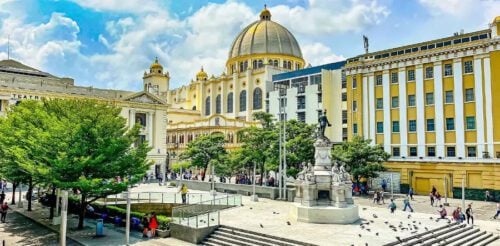
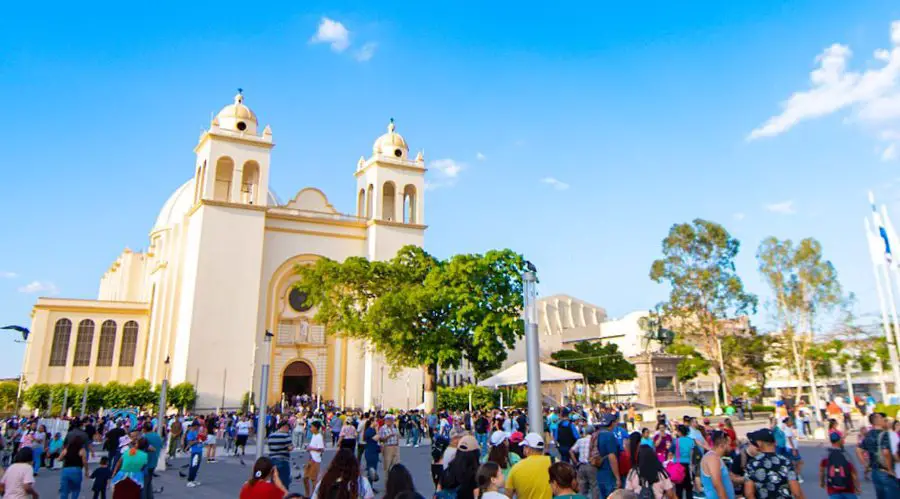
 Downtown San Salvador.
Remittances to El Salvador remain a key driver of the country’s economy. In August alone, Salvadorans living abroad sent $863.4 million, a 4.7% increase compared to August 2025, representing about $38.5 million more in inflows.
The overall remittances trend remains positive. During the first eight months of the year, El Salvador received approximately $6.8 billion in remittances, surpassing the totals recorded during the same period in each of the previous two years.
According to the Central Reserve Bank of El Salvador (BCR), cumulative remittance inflows through August reached 3.8% above the same period in 2025, an increase of approximately $249.0 million.
| 2023 | 2024 | 2025 | 2026 | Change Same Month a Year Ago |
|
|---|---|---|---|---|---|
| January | 602.2 | 599.9 | 676.3 | 759.5 | 83.2 (12.3%%) |
| February | 612.8 | 631.5 | 730.4 | 765.3 | 35.0 (4.8%) |
| March | 721.9 | 688.4 | 863.1 | 910.8 | 47.8 (5.5%) |
| April | 672.6 | 749.4 | 807.2 | 851.1 | 43.9 (5.4%) |
| May | 761.4 | 763.8 | 899.1 | 923.1 | 24.0 (2.7%) |
| June | 695.2 | 669.1 | 865.4 | 850.8 | -14.6 (-1.7%) |
| July | 699.5 | 714.0 | 872.9 | 864.3 | -8.6 (-1.0%) |
| August | 682.8 | 709.1 | 825.0 | 863.4 | 38.5 (4.7%) |
| September | 674.1 | 683.1 | 819.7 | ||
| October | 694.5 | 732.4 | 853.0 | ||
| November | 657.8 | 706.3 | 814.8 | ||
| December | 800.7 | 832.7 | 961.1 | ||
| Totals “Millions” | 8275.4 | 8479.7 | 9987.9 | 6788.3 | +3.8% *YTD |
The United States remains the largest source of remittances to El Salvador, contributing $6.3 billion so far in 2026—equivalent to 92.2% of the total.
Canada follows with $56.8 million (0.8%), while Spain ranks third with $49.5 million (0.7%) and Italy comes fourth with $42.1 million (0.6%).
Crypto Wallet Remittances to El Salvador
After a period of decline, the Central Reserve Bank of El Salvador (BCR) reports that remittances sent through cryptocurrency wallets have increased by 31.4% in the first eight months of 2026.
Between January and August, crypto remittances reached $46.6 million, up from $35.5 million during the same period last year.
Despite the sharp increase, these transactions remain marginal, accounting for just 0.7% of total remittances. In 2025, they accounted for just 0.6% of total remittances.
| 2023 | 2024 | 2025 | 2026 | Change Same Month a Year Ago |
|
|---|---|---|---|---|---|
| January | 8.4 | 6.8 | 2.4 | 5.6 | 3.1 (127.9%) |
| February | 7.6 | 6.4 | 2.3 | 6.0 | 3.8 (166.7%) |
| March | 8.5 | 8.0 | 6.9 | 5.8 | -1.1 (-15.9%) |
| April | 7.5 | 7.7 | 4.4 | 5.7 | 1.3 (30.3%) |
| May | 7.7 | 6.8 | 4.6 | 6.2 | 1.5 (32.5%) |
| June | 7.0 | 6.8 | 4.8 | 6.1 | 1.3 (27.5%) |
| July | 6.5 | 7.2 | 4.9 | 5.7 | 0.9 (18.4%) |
| August | 6.3 | 7.7 | 5.2 | 5.5 | 0.3 (5.8%) |
| September | 6.0 | 7.2 | 4.7 | ||
| October | 5.4 | 7.2 | 5.7 | ||
| November | 5.5 | 6.6 | 6.2 | ||
| December | 6.6 | 7.2 | 5.6 | ||
| Totals “Millions” | 82.9 | 85.5 | 57.7 | 46.5 | 31.4% *YTD |
Remittances by Department
As of July 2026, the San Salvador department leads the country in remittance inflows, receiving 18.3% of the national total, or $1240.8 million.
Remittances to the San Salvador department have increased by 3.1%, compared to the same period in 2025—a $36.9 million increase.
On the other hand, Cuscatlán remains the department with the lowest share, accounting for 2.8% of total remittances, or $190.3 million.
- San Salvador 1240.8
- San Miguel 754.3
- La Libertad 575.2
- Santa Ana 528.4
- Usulután 513.1
- La Unión 478.4
- Chalatenango 396.6
- Sonsonate 351.9
- Morazán 298.9
- Cabañas 297.6
- La Paz 290.4
- Ahuachapán 283.0
- San Vicente 233.8
- Cuscatlán 190.3
Remittances by Municipalities
The San Salvador Center municipality has received the highest volume of remittances so far this year, totaling $745.2 million, or 11.0% of the national figure, an increase of $41.0 million compared to the same period in 2025.
In contrast, the Sonsonate North municipality has recorded the lowest amount, receiving $30.4 million, or 0.4% of the total.
Top Five Municipalities
- San Salvador Centro 745.2
- San Miguel Centro 468.8
- Usulután Este 266.5
- San Salvador Este 254.0
- La Unión Norte 251.6
Bottom Five Municipalities
- San Salvador Sur 54.0
- Chalatenango Norte 50.3
- Santa Ana Este 38.4
- Ahuachapán Norte 35.2
- Sonsonate Norte 30.4
Remittances sent to Salvadorans are pivotal in the nation’s economy, providing vital financial support to many families.
Data from the Multiple Purpose Household Survey (EHPM), published by the Salvadoran Ministry of Economy, indicates that 1.6 million Salvadorans benefit from remittances. Many of these people are in extreme poverty or relative poverty.
Remittances have increased steadily in the last decade; they are a big part of El Salvador’s Gross Domestic Product, GDP.