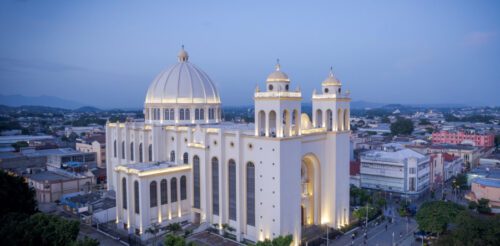
El Rosario Church in the Historic District.
El Rosario Church in San Salvador is a modern catholic building located in downtown San Salvador. El Rosario has a modern architectural design that breaks away from the traditional style of Salvadoran catholic churches.
Locals call it Iglesia El Rosario. It’s an active Catholic church in the San Salvador historic district, a short walk past busy plazas and buildings from different periods of the capital’s history.
Stop by he church, take a seat, and let your eyes adjust. Once you’ve had a chance to watch the light, look for the metal sculptures by Rubén Martínez Bulnes, the Salvadoran artist who designed the church.
Where Is El Rosario Church?
El Rosario stands on the east side of Plaza Libertad, along Sixth Avenue South. From the square, look for the long, curved roof that makes it one of the capital’s most recognizable landmarks.
Plaza Libertad makes a good starting point if you’re looking for things to see and do in San Salvador. You can visit the church first, then continue on foot toward Plaza Gerardo Barrios.

The History of El Rosario Church
San Salvador’s first cathedral once stood here. The building began as the parish church of the Holy Savior of the World, giving this corner of Plaza Libertad a place in the capital’s religious history.
The site also has ties to Central American independence. El Salvador’s Ministry of Culture identifies El Rosario as the burial place of José Matías Delgado, a priest who helped lead the region’s independence movement.
How Today’s Church Took Shape
The original church was made of wood and was destroyed by fire. Therefore, in 1962, Dominican friars Alejandro Peinador and Domingo Iturgaiz commissioned Martínez to design the church that stands today.
At first, the church’s design caused controversy because it did not match the traditional style of Salvadoran Catholic churches. In the end, the Vatican approved the plans instead of the Salvadoran Archdiocese.
Construction began in 1964 and finished in 1971. El Salvador declared the site a historic place in 1972, and the Ministry of Culture recognized the church itself as a cultural asset in 2015.

What Makes El Rosario Church’s Architecture Different?
Martínez used reinforced concrete to create a sweeping arch over the main worship space. With no interior columns breaking up the room, you have a clear view toward the altar from anywhere.
Look up at the stepped sections of the roof. Rectangular panes of colored glass sit in concrete frames, and the rows of windows follow the curve of the arch overhead.
Stained Glass and Metal Sculptures
On sunny days, the glass casts bright bands of color across the interior. When clouds pass, the light softens. Try looking from another area to see how the colors fall from a different angle.
The Stations of the Cross are also worth a closer look. Martínez shaped the figures from metal, using angular forms and rough surfaces that give them a distinct character among El Salvador’s churches.
The ideal time to visit El Rosario is early morning or late afternoon, when light reflected from the stained glass has the most dramatic effect.
The stained-glass windows bring a rainbow of natural light that rushes across the altar and ricochets off the metal and rock found within the walls.
In other words, the stained-glass windows give light, color, and character to the otherwise gloomy interior.

How to Visit El Rosario Church
If you’re coming for the stained glass, try a sunny late afternoon. Give yourself a few minutes to sit inside and see how the light changes as it moves across the concrete.
El Rosario is still a place of worship, so check visiting hours and Mass times before heading downtown. Keep your voice low inside, and check whether photography is allowed during your visit.
What to See Near El Rosario Church
Spend a few minutes in Plaza Libertad before moving on. The monument in the middle commemorates Central American independence, and the open square gives you room to take in the church’s full profile.
Walk west toward Plaza Gerardo Barrios for the Metropolitan Cathedral of San Salvador and the National Palace. After seeing El Rosario’s curved roof, notice how the cathedral’s symmetrical façade frames the entrance.
The National Library of El Salvador, known as BINAES, also faces the square. Its glass exterior adds another architectural style to a short walk that takes you past some of the capital’s best-known buildings.
Why El Rosario Church Is Worth a Stop
El Rosario brings two chapters of San Salvador’s history together. The site takes you back to the city’s first cathedral, while the concrete arch, colored glass, and metalwork show how Martínez reimagined a place of worship.
If you’re looking for more places to visit in El Salvador, give El Rosario time on your downtown walk. See it from Plaza Libertad first, then step inside and let your eyes adjust.