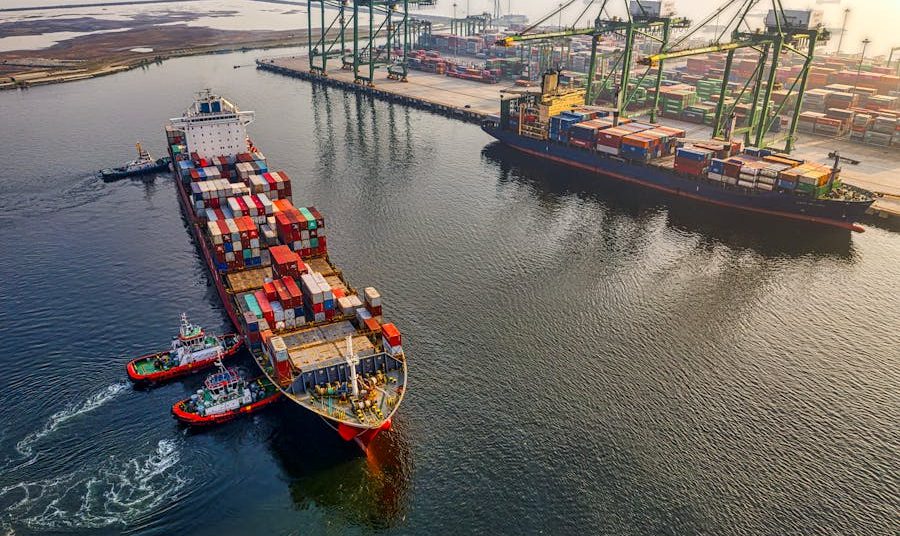
 Shipping Port Indonesia.
 LA LIBERTAD, El Salvador — A sweeping new set of tariffs ordered by President Donald Trump took effect Thursday, intensifying the administration’s hardline trade strategy and sending shockwaves through international markets.
The move caps months of stalled negotiations and signals a new phase in a global trade war that has defined Trump’s second term.
Signed into law on July 31—just one day before the expiration of an extended truce meant to allow for last-minute deals—the tariffs target a broad range of imports from longtime allies and adversaries alike.
The White House states that the revised trade framework is designed to address “unfair” trade deficits and encourage partners to renegotiate terms more favorable to U.S. interests.
The new plan is a tiered tariff structure that imposes a minimum 15% duty on goods from countries where the U.S. runs a trade deficit, and a 10% rate for those with a surplus.
This policy applies to over 40 countries, including much of Latin America, Asia, and Europe.
In Central America, Nicaragua will bear the highest rate in the region at 18%, reflecting a sharp uptick in trade penalties. Costa Rica follows with a 15% tariff, while El Salvador, Guatemala, Honduras, and Panama each face a 10% tariff.
These new rates represent a significant departure from previous regional trade norms and are expected to have far-reaching economic implications.
The tariffs also went into effect against major economic powers, including the United Kingdom, China, Japan, South Korea, the Philippines, Indonesia, the European Union, and Vietnam.
Additionally, Washington unilaterally imposed duties on nations that failed to secure deals before the truce deadline—among them India, Switzerland, South Africa, and Venezuela.
India, now facing a 25% tariff, is set to receive a second 25% surcharge on Russian oil imports in 21 days, as part of a broader geopolitical pressure campaign.
Brazil was hit with a 50% tariff on Wednesday, which Trump framed as retaliation for what he called the “unfair” treatment of former Brazilian President Jair Bolsonaro.
Mexico was granted a 90-day extension to continue talks, while Canada’s tariffs will rise from 25% to 35% on August 1.
Trump’s executive order also locked in several negotiated reductions: the European Union saw duties on most goods drop from 30% to 15%, and Cambodia, Lesotho, and Vietnam all received substantial cuts.
China reached a temporary agreement with the U.S., under which Washington slashed tariffs on Chinese goods from 145% to 30%.
Beijing reciprocated by reducing duties on American exports from 125% to 10% and lifting restrictions on critical materials, such as semiconductors and rare earths. Both sides are racing to finalize a longer-term deal before a self-imposed August 12 deadline.
Trump first rolled out the plan on April 2, calling it “Liberation Day,” and since then, the administration has adjusted it in response to months of diplomatic pressure and international pushback. Some countries managed to secure better terms, while others are now facing steeper penalties.
Critics warn that the tariff hikes could fuel inflation, spark retaliatory trade measures, and disrupt global supply chains. But Trump remains unmoved, framing the tariffs as necessary tools to restore American manufacturing strength and rebalance global trade in favor of the United States.