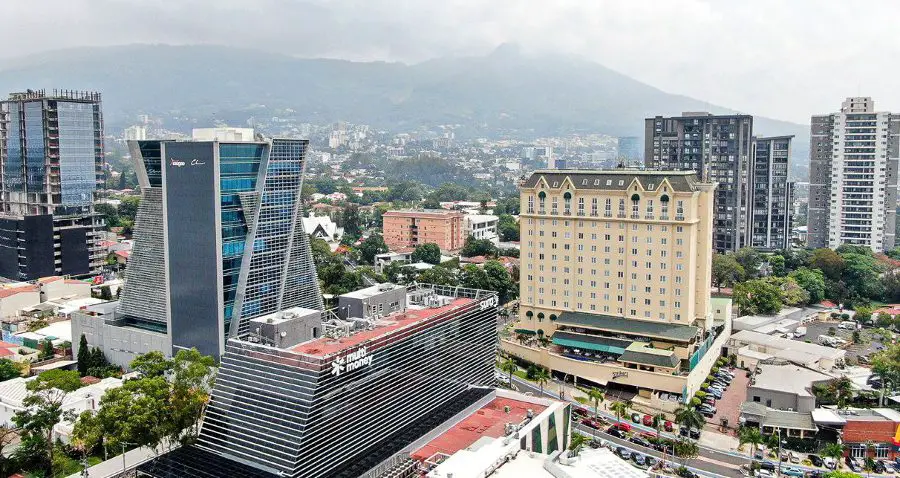
 San Salvador, El Salvador Capital City
The International Monetary Fund (IMF) projects that El Salvador’s economy will grow by 4.5% in 2026, placing the country above the expected growth rate for Latin America and the Caribbean.
The latest projection also represents an improvement from the IMF’s previous outlook. It falls within the 4.5% to 5% growth range forecast by El Salvador’s Central Reserve Bank (BCR).
The IMF says economic activity in the country is expected to maintain the positive momentum recorded in recent years, with construction, tourism, exports, services, trade, and private investment contributing to the country’s economic expansion.
According to the IMF, El Salvador’s projected 4.5% growth would exceed the 2.3% expansion anticipated for Latin America and the Caribbean as a whole during 2026.
IMF Announces Agreement for $140 Million Disbursement to El Salvador
The International Monetary Fund reached a staff-level agreement with Salvadoran authorities on the combined second and third reviews of the country’s $1.4 billion financing program, which was approved in 2025.
The agreement still requires approval from the IMF’s executive board. Once approved, El Salvador would gain access to about $140 million, bringing total disbursements under the program to a higher level.
The IMF said the economic program continues to produce positive results. Economic activity has performed better than initially expected, while the country has made progress in addressing fiscal and external imbalances.
“The Salvadoran economy continues to show solid performance,” Pedro Torres, the IMF’s mission chief for El Salvador, said following discussions between the organization’s staff and Salvadoran authorities on the program.
The IMF said El Salvador’s real gross domestic product grew faster than expected in 2025. The organization now projects the Salvadoran economy will expand by 4.5% in real terms during 2026.
What Other Institutions Expect in 2026
The International Monetary Fund expects El Salvador’s economy to grow 4.5% in 2026, matching the World Bank’s latest projection and signaling a stronger outlook than ECLAC’s estimate.
The World Bank and the Economic Commission for Latin America and the Caribbean (ECLAC) also forecasts a 4.5% growth this year.
The Salvadoran Central Reserve Bank has the most optimistic outlook among the institutions. It projects economic growth between 4.5% and 5%, placing the IMF’s forecast at the lower end of that range.
Overall, the IMF and World Bank share the same expectations for 2026. Their 4.5% projections stand 0.6 percentage points above ECLAC’s forecast but remain below the Central Reserve Bank’s upper estimate.
The BCR noted that the current forecast surpasses the roughly 2% average recorded between dollarization in 2001 and 2019, as well as the 2.3% average registered from 2014 through 2018.
Private investment is expected to be one of the principal engines of economic activity during 2026, supported by improved business confidence, public-security conditions, and government efforts to attract additional investment.
According to the BCR, El Salvador has a portfolio of private investment projects valued at more than $9 billion, involving infrastructure, machinery, equipment, construction, services, commerce, tourism, and other economic activities.