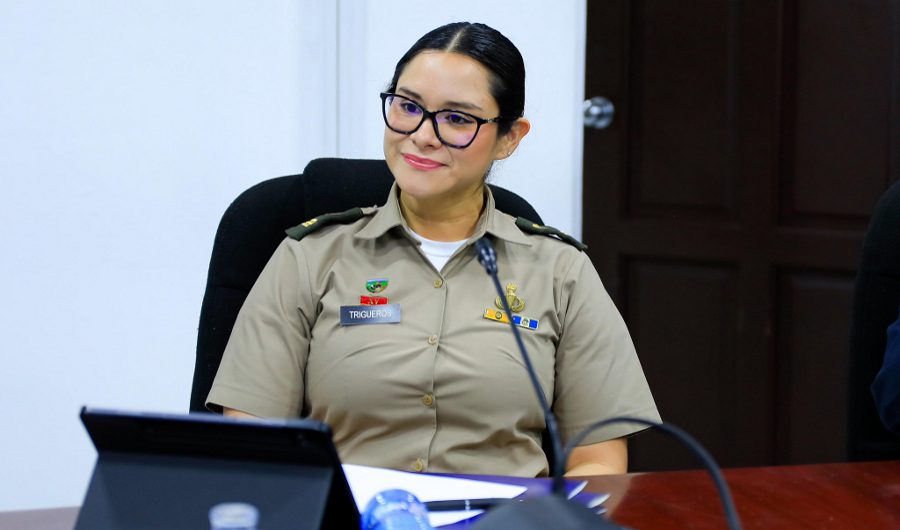
 Salvadoran Minister of Education, Karla Trigueros.
SANTA TECLA, El Salvador (AP) — El Salvador’s Ministry of Education plans to introduce artificial intelligence in public classrooms beginning in 2026, Minister of Education Karla Trigueros told lawmakers Thursday while outlining the institution’s proposed budget, a move officials say will reshape the national learning model.
Trigueros announced the initiative during her presentation to the Legislative Assembly’s Finance Committee, where she said AI tools will support teachers as part of the government’s “My New School” reform.
She emphasized that efforts to integrate technology and close the digital divide will accelerate next year.
The 2026 budget assigns $301.1 million to educational reform projects, including $200 million in external loans. The minister stated that the funds will support expanded connectivity, equipment distribution, and the development of new digital learning platforms for students and teachers.
Trigueros mentioned that tablets and computers will continue to be provided to students at all grade levels. At the same time, the program Links with Education or “Enlaces con la Educación” will aim to reduce connectivity gaps.
The “Links with Education or Enlaces con la Educación” program is a government initiative in El Salvador aimed at closing the digital divide in the public education system, providing computers and tablets to students and teachers in early childhood, primary, and secondary education.
Additionally, she noted that teachers will receive digital tools, including AI applications, although she did not provide specific details on how these tools will be implemented.
Currently, “Links with Education” relies on Google platforms under a government agreement.
Trigueros did not address concerns about scheduling changes but confirmed that videos, digital books, educational games, and complete content ecosystems are already produced. She said students will access these resources through government-issued devices.
The minister added that 46,000 teachers will receive training aligned with the new curriculum. School principals will also undergo leadership training as part of the transition to the restructured model.
The reform also includes major content revisions. Trigueros said the initiative will replace “outdated curricula” and distribute six million updated textbooks across grade levels. She described the overhaul as essential for adapting technical education to the country’s current reality.
Regarding infrastructure, the ministry plans to continue school remodeling in 2026, with a projected investment of $140 million, funded by a loan from the Central American Bank for Economic Integration.
Trigueros highlighted progress under the “Two Schools a Day” initiative, noting 70 schools were delivered on November 2. Only two were built directly by the Education Ministry; most were completed by the Ministry of Public Works using inmate labor.
Introducing artificial intelligence in public classrooms could help El Salvador address its chronic education gap, where the average Salvadoran completes only 7.4 years of education.
AI tools can offer consistent support, personalized practice, and structured guidance in schools that lack resources.
Adaptive platforms can help teachers manage varied skill levels while reinforcing basics for students who fall behind, a common issue in classrooms with wide learning disparities.
If deployed responsibly, artificial intelligence could modernize instruction, improve learning outcomes, and provide students with better trajectories than the limited schooling levels that currently dominate—helping the country break a long-standing cycle of educational underachievement.