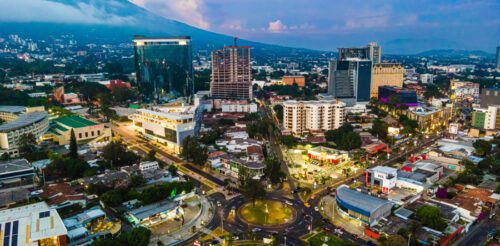
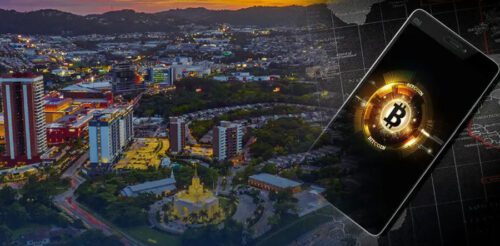
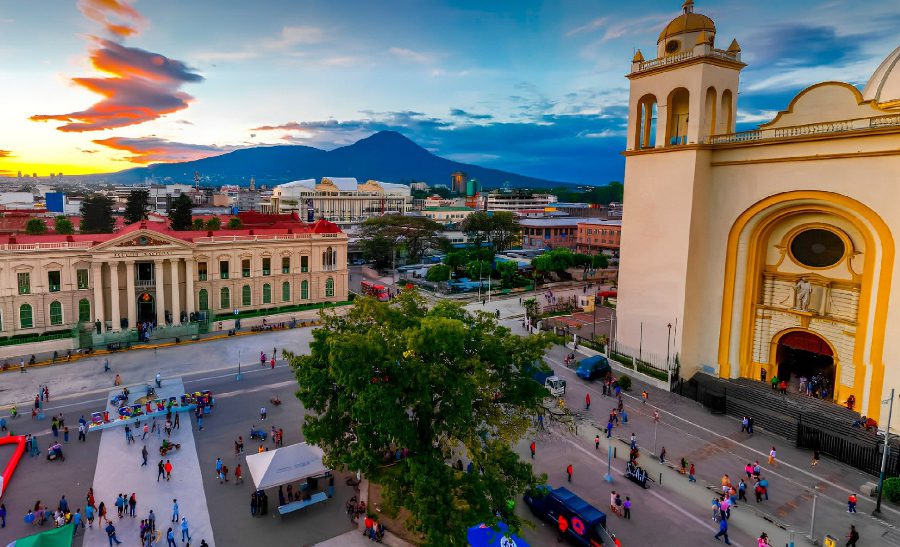
 Downtown Historic District in San Salvador.
Remittances are more than money transfers in El Salvador—they are lifelines. Every dollar sent home represents survival, stability, and sacrifice, shaping both households and the nation’s economic trajectory.
For decades, Salvadorans living abroad, especially in the United States, have supported their families back home. These remittances have become one of the country’s most essential financial lifelines, steadily increasing year after year.
Today, remittances represent over 20% of El Salvador’s gross domestic product (GDP), making them one of the highest dependency ratios in the world. This dependence brings both benefits and vulnerabilities.
Historical Roots of Remittances in El Salvador
During the Salvadoran civil war of the 1980s, hundreds of thousands migrated, fleeing violence and instability. As they built lives abroad, remittances became a vital means of survival for their relatives back home.
By the 1990s, remittance flows solidified into a predictable, large-scale financial source. Policymakers began to acknowledge their importance, even as concerns about overdependence quietly surfaced in academic and economic circles.
In the 2000s, gang violence in El Salvador forced many to migrate in search of work and safety, leaving families behind increasingly dependent on remittances as their primary source of survival and stability.
The civil war and gang violence laid the foundation for today’s reality: an economy heavily reliant on external income rather than its own internal productive capacity, leaving El Salvador structurally vulnerable to outside forces.
The Scale of Remittances in Today’s Economy
In 2023, Salvadoran remittances reached $8.3 billion, a remarkable achievement for a country with a population of just over six million people. These inflows continue to rise annually.
In 2024, remittances increased by 2.5% from the previous year, totaling 8.5 billion. As of August 2025, remittances to El Salvador have risen by 18.3% and are on track to reach 9.8 billion for the year.
Over two million Salvadorans living in the United States send most of the remittances, directly supporting their families back home and keeping El Salvador’s foreign exchange earnings flowing.
In 2024, 91.6% of total remittances, amounting to 7.8 billion, originated in the U.S. So far in 2025, remittances from the United States have totaled 6 billion, accounting for 92.5% of the total.
Household Impact of Remittances
At the household level, remittances mean having food on the table, paying tuition, accessing healthcare, and improving housing conditions. They are often the difference between poverty and relative comfort.
Families benefiting from remittances generally experience better living conditions than those without. This financial cushion helps reduce inequality gaps between urban and rural populations, at least among recipient families.
Yet, reliance creates divisions. Many households without access to remittances remain trapped in poverty, fueling frustration and deepening economic inequality across Salvadoran society.
Broader Economic Influence of Remittances
Remittances drive domestic consumption, fueling sectors such as retail, housing, and services. They help stabilize the banking system by supplying foreign exchange and fueling steady financial inflows.
However, most remittances support consumption rather than production. Few are invested in business creation, agriculture, or manufacturing—areas that generate sustainable jobs and long-term economic resilience.
This imbalance contributes to El Salvador’s ongoing trade deficit, as remittance-fueled consumption often favors imported goods over local production, undermining industrial and agricultural competitiveness.
Political and Social Dimensions
Remittances extend beyond economics—they are political. Governments have long relied on them as a safety valve, reducing pressure to deliver substantial social and economic reforms domestically.
Politicians actively court diaspora communities, recognizing their significant influence on national politics. Recent electoral reforms even expanded voting rights abroad, reinforcing the diaspora’s influence on Salvadoran affairs.
Remittances keep family ties strong across borders, but they also make migration seem like the go-to fix for a family’s economic problems, reinforcing ongoing cycles of dependence.
Challenges and Risks of Dependence
Overdependence on remittances makes El Salvador vulnerable to U.S. economic swings, immigration policy changes, and labor market fluctuations. A downturn could instantly destabilize thousands of households.
The inflows also pressure the housing market. Remittance-funded construction increases property values, making homeownership unattainable for many locals without external income support, which in turn fuels resentment and perpetuates inequality.
Looking ahead, remittances will continue to play a central role in El Salvador’s economy. The real challenge is transforming them from short-term consumption into tools for long-term productive investment and development.
Remittances: Blessing and Burden
Remittances are El Salvador’s economic lifeline—fueling growth, reducing poverty, and sustaining families. Yet dependence comes at a cost, exposing vulnerabilities and stunting domestic economic transformation.
El Salvador’s economic future depends on whether policymakers turn those billions into real development, not just survival, and cut down the country’s long-term reliance on money coming from abroad.
Until then, remittances remain both El Salvador’s blessing and its burden, reflecting a nation built as much abroad as within its own borders.