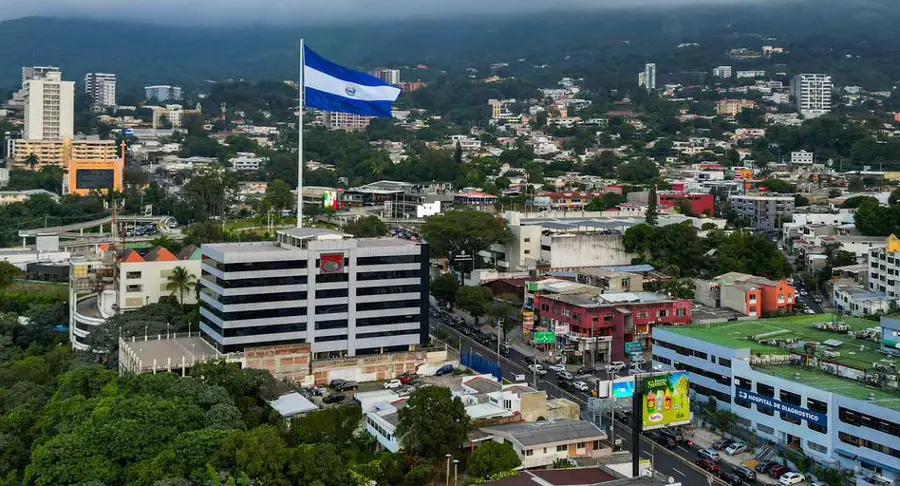
 San Salvador, El Salvador Capital City.
Remittances to Latin America and the Caribbean are forecast to reach a record $174.4 billion in 2025, the Inter-American Development Bank stated Tuesday, mainly driven by Central America’s sharp growth amid migration uncertainties that are spurring higher transfers.
The IDB reports that the region will see a 7.2% annual increase in remittances next year, marking the sixteenth consecutive year of growth. Central America is leading this surge with an estimated 20.4% rise, totaling $55.395 billion.
Analysts say migrants responded to uncertainty in the United States—the source of 56.7% of remittances—by sending larger amounts earlier in the year, often drawing from savings to support relatives amid shifting immigration signals.
Central America now accounts for nearly one-third of all remittances to Latin America. Honduras received the largest share of Central American inflows, at 26%, followed by Guatemala at 20.2%, Nicaragua at 18.2%, and El Salvador at 17.9%.
The economic weight of these funds is substantial across the subregion. Remittances equal 30.4% of Honduras’ GDP and about 30% of GDP in both El Salvador and Nicaragua, underscoring long-standing dependence on migrant income.
Mexico remains the top regional recipient with $61.81 billion, despite a 4.5% decline from 2024. The drop stems from a base effect linked to last year’s peso depreciation, rather than weakening support from Mexican migrants.
Mexico’s remittances, while large in volume, represent only 3.3% of national GDP, illustrating its comparatively lower reliance on these external transfers compared with Central American economies increasingly shaped by migrant earnings.
The Caribbean is projected to receive $20.883 billion in 2025, a 9.2% increase and roughly 12% of the regional total. South America will collect $36.339 billion, up 10.9%, representing about one-fifth of total regional flows.
Ecuador and Colombia are the fastest-growing countries in South America. Colombia will receive $13.379 billion, up 12.9% and equal to 3.1% of GDP. Ecuador’s inflows will rise 21% to $7.916 billion, representing 6.1% of its economy.
The Inter-American Development Bank states that remittances help reduce poverty, but the poorest families rarely see that money. Families with very low incomes often can’t afford to migrate, so they miss out on opportunities to earn money from abroad.
Felipe Muñoz, head of the IDB’s Migration Unit, said migration requires upfront resources that the poorest families cannot secure, limiting their ability to participate in mobility-driven economic gains.
The report warns that more rigid U.S. immigration rules or fewer job opportunities could soon slow remittance growth, putting a key source of income at risk for millions of families in the region. El Salvador’s economy leans heavily on remittances—they’re simply part of everyday Salvadoran life.