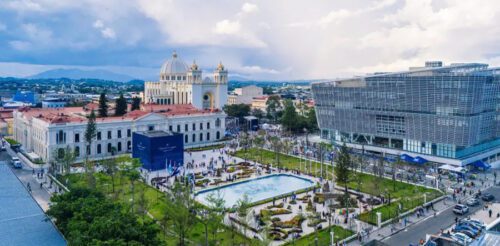
San Salvador Historic Downtown.
The inflation rate in El Salvador incresed to 3.19% in August 2026, marking the highest level this year and the highest in three years, according to data from the Central Reserve Bank (BCR).
The rate represented an increase of 0.70 percentage points compared to the 2.49% registered in July 2026. Over the last twelve months, inflation has risen by 3.30 percentage points, moving from -0.11% in August 2025 to the current 3.19%.
| 2023 | 2024 | 2025 | 2026 | Change Same Month a Year Ago |
|
|---|---|---|---|---|---|
| January | 7.03 | 1.20 | 0.31 | 0.65 | 0.34 |
| February | 6.82 | 0.80 | 0.06 | 1.17 | 1.11 |
| March | 6.06 | 0.77 | 0.14 | 1.47 | 1.33 |
| April | 5.44 | 1.14 | -0.11 | 2.16 | 2.27 |
| May | 4.41 | 1.42 | -0.21 | 2.53 | 2.74 |
| June | 3.78 | 1.48 | -0.17 | 2.76 | 2.93 |
| July | 3.34 | 1.78 | -0.14 | 2.49 | 2.63 |
| August | 3.09 | 1.17 | -0.11 | 3.19 | 3.30 |
| September | 3.02 | 0.58 | 0.36 | ||
| October | 2.66 | -0.07 | 0.93 | ||
| November | 2.11 | -0.31 | 1.14 | ||
| December | 1.23 | 0.29 | 0.91 |
According to the BCR, the transportation sector has posted the largest increase in inflation so far this year. Its rate rose from -1.64% in December 2025 to 8.23% in August 2026, an increase of 9.87 percentage points.
Food and Non-Alcoholic Beverages Rate
One of the most important components of the Consumer Price Index (CPI) is Food and Non-Alcoholic Beverages, as it directly impacts the cost of the country’s basic food basket (CBA) and the purchasing power of Salvadoran households.
Between December 2025 and August 2026, inflation in this category rose from 1.29% to 3.65%, an increase of 2.36 percentage points.
On a year-over-year basis, food and non-alcoholic beverage inflation increased by 4.89 percentage points, climbing from -1.24% in August 2025 to 3.65% in August 2026.
| 2023 | 2024 | 2025 | 2026 | Change Same Month a Year Ago |
|
|---|---|---|---|---|---|
| January | 12.22 | 3.60 | -0.49 | 0.89 | 1.38 |
| February | 12.61 | 2.15 | -0.55 | 1.38 | 1.93 |
| March | 11.62 | 2.21 | -0.99 | 2.66 | 3.65 |
| April | 10.36 | 2.34 | -0.63 | 2.99 | 3.62 |
| May | 8.35 | 2.71 | -0.69 | 2.85 | 3.54 |
| June | 6.93 | 3.63 | -1.44 | 3.02 | 4.46 |
| July | 6.40 | 4.53 | -1.85 | 2.49 | 4.34 |
| August | 6.11 | 3.12 | -1.24 | 3.65 | 4.89 |
| September | 5.98 | 1.21 | 0.53 | ||
| October | 5.91 | -0.34 | 141 | ||
| November | 4.70 | -0.70 | 2.28 | ||
| December | 3.98 | -0.47 | 1.29 |
The August 2026 Salvadoran basic food basket figures are still pending, but in July 2026, it reached $261.49 in urban areas and $186.51 in rural areas.
Increased inflation in the food and non-alcoholic beverages sectors has led to higher costs for basic food items that Salvadoran families rely on.
Inflation Rate in El Salvador
While global inflation continues to challenge economies worldwide, El Salvador’s inflation rate has remained relatively low.
Officials credit this stability to a series of economic measures implemented by President Nayib Bukele’s administration, which has helped keep the country’s inflation among the lowest in Latin America.
Despite recent improvements, economic experts warn that inflation remains a key issue, influencing purchasing power, the cost of living, and broader economic performance.