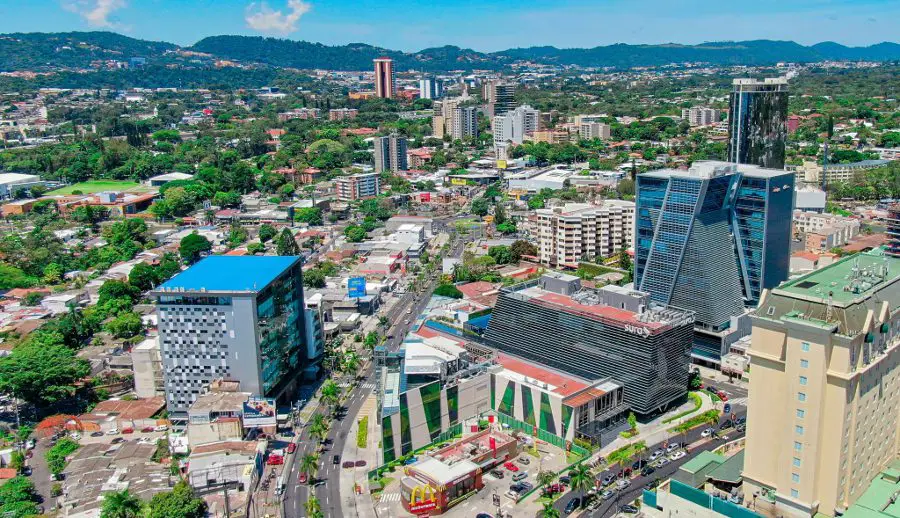
 Zona Rosa, San Salvador.
 As of August 2026, El Salvador’s credit ratings are B- with a stable outlook from Standard & Poor’s, B- with a stable outlook from Fitch Ratings, and B3 with a stable outlook from Moody’s.
| Agency | Rating | Outlook |
|---|---|---|
| Standard & Poor’s | B- | Stable |
| Fitch Rating | B- | Stable |
| Moody’s | B3 | Stable |
The outlook for El Salvador’s economy in 2026 remains positive, although growth forecasts vary among international organizations.
The International Monetary Fund (IMF) expects the Salvadoran economy to grow by 3.3%. In comparison, the Economic Commission for Latin America and the Caribbean (ECLAC) projects slightly stronger growth of 3.9%.
The World Bank has a more conservative outlook, forecasting economic growth of 3.2% for El Salvador in 2026.
Meanwhile, the Central Reserve Bank of El Salvador (BCR) is more optimistic, projecting growth between 4.5% and 5%, well above the estimates from international organizations.
Standard & Poor’s Rating
S&P Global Ratings maintained El Salvador’s credit rating at B- with a stable outlook, pointing to improvements in the country’s economic and fiscal situation as key factors behind its decision.
According to S&P, the stable outlook also reflects El Salvador’s access to several financing options that could help the government meet its financial obligations and manage upcoming debt payments.
These financing sources include multilateral institutions, domestic institutional investors and international debt markets. Together, they give the government more options to secure funding when it needs additional resources.
| Date | Rating | Outlook |
|---|---|---|
| August 2026 | B- | Stable |
| August 2025 | B- | Stable |
| September 2023 | B- | Stable |
| May 2023 | CCC+ | Stable |
| May 2023 | SD | Negative |
| June 2022 | CCC+ | Negative |
| October 2021 | B- | Negative |
Fitch Ratings
In April 2026, Fitch Ratings affirmed El Salvador’s long-term foreign-currency sovereign debt rating at B- with a stable outlook, reflecting improved financing conditions alongside several ongoing fiscal and debt challenges.
| Date | Rating | Outlook |
|---|---|---|
| April 2026 | B- | stable |
| November 2025 | B- | stable |
| January 2025 | B- | stable |
| May 2023 | CCC+ | — |
| January 2023 | CC | — |
| September 2022 | CC | — |
| July 2022 | CCC | — |
| February 2022 | CCC | — |
According to Fitch Ratings, the Stable Outlook reflects the country’s expectations for stronger economic growth and continued improvements in government finances.
Fitch Ratings notes that this rating is based on the country’s reduced financing needs, despite a “prolonged delay” in fulfilling its agreement with the International Monetary Fund (IMF).
The Stable Outlook reflects Fitch’s expectation that El Salvador’s stronger economic growth and fiscal consolidation process will continue. However, we expect higher oil prices will create headwinds, and there is uncertainty regarding the fate of the IMF program (currently subject to a prolonged delay), and the government’s plans to address resumption of interest payments on pension-related debt in 2027. Fitch Rating Agency.
Moody’s Rating
In November 2024, the rating agency Moody upgraded El Salvador’s credit rating from Caa3 to B3 and maintained its stable outlook for the country.
The Salvadoran government has made three bond buybacks in 2024, and the Ministry of Finance states that this has saved the country $745 million.
| Date | Rating | Outlook |
|---|---|---|
| November 2024 | B3 | Stable |
| February 2023 | Caa3 | Stable |
| May 2022 | Caa3 | Negative |
| July 2021 | Caa1 | Negative |
| February 2021 | B3 | Negative |
| November 2020 | B3 | Under Review |
| March 2020 | B3 | Positive |
El Salvador Credit Ratings
El Salvador’s credit ratings matter because they shape borrowing costs, influencing national budgets, investment decisions, and long-term economic planning across all sectors.
Lower ratings raise financing costs, limit access to international markets, and pressure public services, infrastructure development, and fiscal stability nationwide.
These ratings also affect daily life in El Salvador by influencing interest rates, job creation, business confidence, and the overall cost of living, ultimately shaping household economic security.